Huge potential for bioplastics
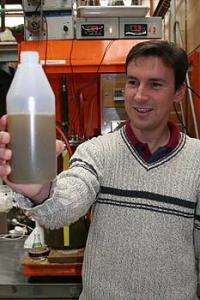
It almost sounds too good to be true - turning cow pats into plastic. But the unlikely-looking liquid in the flask Dr Steven Pratt holds is the key ingredient to an environmentally friendlier drink bottle.
The murky mix of acids is produced by fermenting bacteria taken from wastewater ponds and fed with a glucose solution. A glucose solution is used in this laboratory situation, but the bacteria will feed with equal efficiency on dairy-farm effluent or other carbon-based wastewater.
It is the renewable and biodegradable nature of such ingredients that give the types of plastic produced from the acids the classification of ‘bio-plastics’.
A researcher in the Centre for Environmental Technology and Engineering, Dr Pratt says the potential for bioplastic production in New Zealand is huge.
“The waste produced by our agricultural and pulp and paper industries is ideal, and there is so much of it.”
He says plastics are a major environmental problem as they are non-biodegradable and their production from synthetic polymers consumes vast quantities of non-renewable resources.
“By using cheap and renewable sources there is a tremendous opportunity for biopolymer production to be made economic. At the same time, the problems of wastewater treatment and natural resource depletion are addressed.”
He says some acids are better than others for the production of bio-plastic. For example, acetic acid-based plastic is comparatively brittle to that produced from other acids; it has been shown that the inclusion of propionic acid produces polymer chains (the building blocks of plastic) with the favourable characteristic of malleability.
The task of producing one particular acid, however, is complicated by the diversity of the constituents of raw wastewater and effluent.
Part of Dr Pratt’s project looks at controlling the fermentation procedure by adjusting factors such as pH so that only one kind of acid is produced. His team of postgraduate students are also focusing on a stage in the fermentation process that is typically ignored.
“Fermentation has been around for thousands of years, and the science of fermentation has been understood for quite some time, but no-one has really looked at what happens in transient stages.”
A transient stage occurs when bacteria are shocked by the input of food (in this case, carbon-based effluent) or when conditions such as pH are altered. The micro-organisms react to these changes in interesting ways before evening out and producing a consistent volume of mixed acids.
“In this transient stage one type of acid may be made in greater proportions, and other unknown or unexpected compounds can also be made. Sometimes the most interesting things are made when things go wrong.”
Source: Massey University


