Researchers Create New Organic Gel Nanomaterials
Jun 28, 2006
Researchers Create New Organic Gel Nanomaterials
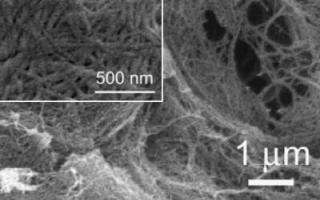
Scanning electron microscope image shows organogel fibers in ethyl acetate. Credit: Rensselaer/Dordick

Researchers have created organic gel nanomaterials that could be used to encapsulate pharmaceutical, food, and cosmetic products and to build 3-D biological scaffolds for tissue engineering. Using olive oil and six other liquid solvents, the scientists added a simple enzyme to chemically activate a sugar that changed the liquids to organic gels.

"We are using the building blocks provided by nature to create new nanomaterials that are completely reversible and environmentally benign," said Jonathan Dordick, the Howard P. Isermann '42 Professor of Chemical and Biological Engineering at Rensselaer Polytechnic Institute. "The importance of this finding is the ability to use the same naturally occurring enzyme both to create chemically functional organogels and to reverse the process and break down these gels into their biologically compatible building blocks."
Researchers Create New Organic Gel Nanomaterials
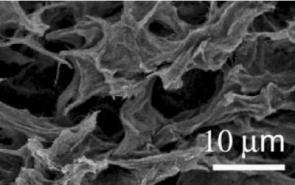
Scanning electron microscope image shows self-supporting organogel scaffold after UV polymerization in ethyl acetate. Credit: Rensselaer/Dordick

In the experiments, researchers activated a sugar using a simple enzyme, which generated a compound that self-assembles into 3-D fibers measuring approximately 50 nanometers in diameter. As the fibers entangle, a large amount of solvent gets packed together, trapping some 10,000 molecules.

The resulting organogel materials could be used as biocompatible scaffolds for tissue engineering and designing membranes, according to Dordick. Other possible applications include delivery systems for pharmaceuticals and preservatives for food and cosmetics.

"The development of new materials that are molecularly defined and chemically functional at the nanoscale is of critical importance to biological applications such as drug delivery," said Dordick. "We are finding the natural world has provided tools to create these materials without the need to generate new compounds that may be harmful to the body or environment."

The findings are currently available online in advance of print publication July 17 by the journal Angewandte Chemie.

Dordick's research involves using enzyme technology to produce unique chemical structures with applications in drug discovery, materials science, and chemical technology.

Source: Rensselaer Polytechnic Institute

Explore further: How nanotechnology could keep your heart healthy

add to favorites email to friend print save as pdf

Related Stories

Graphene joins the race to redefine the ampere

17 hours ago

A new joint innovation by the National Physical Laboratory (NPL) and the University of Cambridge could pave the way for redefining the ampere in terms of fundamental constants of physics. The world's first ...

New magnetic graphene may revolutionise electronics

May 10, 2013

Researchers from IMDEA-Nanociencia Institute and from Autonoma and Complutense Universities of Madrid (Spain) have managed to give graphene magnetic properties. The breakthrough, published in the journal ...

Biomaterial shows promise for Type 1 diabetes treatment

May 09, 2013

(Phys.org) —Researchers have made a significant first step with newly engineered biomaterials for cell transplantation that could help lead to a possible cure for Type 1 diabetes, which affects about 3 ...

Recommended for you

How nanotechnology could keep your heart healthy

May 17, 2013

Since the heart is such a delicate and critical organ, clinicians usually opt not to intervene with the dead cells that remain after a heart attack or cardiac disease. "But we think that all heart attacks deserve some kind ...

User comments : 0

More news stories

Kinks and curves at the nanoscale

One of the basic principles of nanotechnology is that when you make things extremely small—one nanometer is about five atoms wide, 100,000 times smaller than the diameter of a human hair—they are going ...

Catching graphene butterflies

Writing in Nature, a large international team led Dr Roman Gorbachev from The University of Manchester shows that, when graphene placed on top of insulating boron nitride, or 'white graphene', the electr ...

Heat-related deaths in Manhattan projected to rise

Residents of Manhattan will not just sweat harder from rising temperatures in the future, says a new study; many may die. Researchers say deaths linked to warming climate may rise some 20 percent by the 2020s, ...

Honeybees trained in Croatia to find land mines

(AP)—Mirjana Filipovic is still haunted by the land mine blast that killed her boyfriend and blew off her left leg while on a fishing trip nearly a decade ago. It happened in a field that was supposedly ...