New Deep-Sea Hybrid Vehicle Gets a Mythical Name
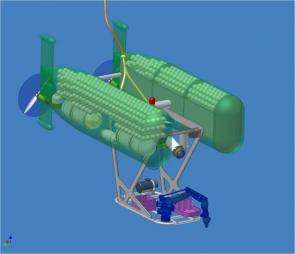
Nereus, a mythical god with the torso of a man and the tail of a fish, was chosen June 25 as the name of a new deep-sea vehicle under construction at the Woods Hole Oceanographic Institution (WHOI).
The vehicle, known until now as the Hybrid Remotely Operated Vehicle, or HROV, will be able to work in the deepest parts of the ocean, from 6,500 meters to 11,000 meters (21,500 feet to 36,000 feet), a depth currently unreachable for routine ocean research. Scientists also plan to use it to explore remote, difficult-to-reach areas, including under the Arctic ice cap.
Engineers and ship's crew will transform Nereus from a free-swimming vehicle for wide-area ocean surveys to a vehicle tethered by a cable to a surface ship for close-up investigation and sampling of seafloor rocks and organisms. The transformation will take 6 to 8 hours and happen on the ship's deck.
The $5-million, battery-operated vehicle will be the first ever designed to transform from a guided, tethered robot to a free-swimming vehicle. Nereus (rhymes with “serious”) keeps with a tradition in the WHOI Deep Submergence Laboratory of naming vehicles for mythical Greek figures. Among others in the WHOI-operated fleet of vehicles are Jason (a fabled adventurer and ocean explorer), Argo (a ship used by Jason), and Medea (the mythical wife of Jason).
“Nereus best fits the image of our vehicle, which engineers can change shape at sea for various science needs,” said Andy Bowen, the WHOI engineer overseeing the vehicle’s design and development. The vehicle is scheduled for sea trials in early 2007, and scientists plan to use it for research later that year at Challenger Deep near Guam, the deepest spot in the world’s oceans.
The Challenger Deep was first visited in 1960 by the U.S. Navy bathyscaphe Trieste, and again in 1995 by the Japanese remotely operated vehicle Kaiko, which has later lost on an unrelated expedition.
Bowen was among a panel of judges from WHOI and engineering consulting groups that selected Nereus from 22 entries in a naming contest open to junior high, high school, and college students who participate in the California-based Marine Advanced Technology (MATE) Center.
Nereus was announced the winner during a June 25 awards banquet at the NASA Johnson Space Center in Houston. The prize for the winning team is a trip this September to see the HROV in Woods Hole, where Bowen said engineers expect to be concluding tests on the vehicle’s manipulator arm, thruster, pressure housings, and electronic components.
Source: Woods Hole Oceanographic Institution


