Proper UV protection for your eyes is important for summer
Jun 20, 2006
Proper UV protection for your eyes is important for summer
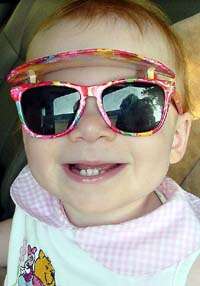
Because it takes years of UV radiation exposure to contribute to the formation of a cataract or damage in the retina, it's very important to get sunglasses with UV protection, to wear them at an early age and to keep wearing them as you get older, says an optometrist at Washington University's School of Medicine. Photo courtesy of WUSTL

We all know the importance of using sunscreen to protect our skin from the sun's harmful rays, but what about protection for our eyes? July is UV Safety Month and prolonged exposure to the sun's ultraviolet rays without protection may cause eye conditions that can lead to vision loss, such as cataracts and age-related macular degeneration. Sunglasses and wide-brimmed hats are your best protection against UV-related vision problems, but be careful when you're shopping for sunglasses -- the wrong kind of lenses might do more harm than good.

Mary Migneco, O.D., an instructor in the Department of Ophthalmology and Visual Sciences at the university's School of Medicine says that "The darkness that you see in sunglasses cuts out the visible UV rays. What's really harmful to your eyes, however, is the invisible UV, or ultraviolet radiation."

Migneco says that because tinted lenses block the glare from sunlight, sunglasses that don't have UV protection can actually contribute to eye damage.

"When the visible light rays are cut out, your pupil will dilate in order to allow more light into your visual system. If they are not UV protected, the sunglasses are actually doing more harm than good," says Migneco, who sees patients at the BJC Vision Center in St. Louis. "You're letting in more of the harmful UV rays by having your pupil dilated."

So, Migneco says it's important to look for labels on sunglasses and make sure the lenses are coated so that they block both types of UV radiation: UVA and UVB.

"UVB are more harmful than UVA, and they can lead to formation of cataracts and a condition on the back of the eye called macular degeneration. We want to be protected from both UVA and UVB rays. Generally speaking, anything marketed as UV protected is protected against both," adds Migneco.

If sunglasses are UV protected, they will have a sticker on them labeled from OSHA that says they are UVA and UVB protected. If there's no label on the lens, don't assume they are, Migneco warns., and, doctor's across the nation are urging Americans to protect their eyes and their children's eyes by wearing sunglasses and wide-brimmed hats.

Source: WUSTL

Explore further: Bullying and suicide among youth is a public health problem

add to favorites email to friend print save as pdf

Related Stories

City-life changes blackbird personalities, study shows

5 hours ago

The origins of a young animal might have a significant impact on its behavior later on in life. Researchers at the Max Planck Institute for Ornithology in Radolfzell, Germany, have been able to demonstrate ...

Origins of 'The Hoff' crab revealed (w/ Video)

5 hours ago

The history of a new type of crab, nicknamed 'The Hoff' because of its hairy chest, which lives around hydrothermal vents deep beneath the Southern Ocean and Indian Ocean, has been revealed for the first ...

Research shows moves to ban pay-to-delay deals are justified

5 hours ago

Controversial deals that delay generic versions of drugs coming onto the market can lead to consumers paying significantly more for some treatments, according to new research by an academic from the University of East Anglia ...

Recommended for you

Antioxidant shows promise in Parkinson's disease

6 minutes ago

Diapocynin, a synthetic molecule derived from a naturally occurring compound (apocynin), has been found to protect neurobehavioral function in mice with Parkinson's Disease symptoms by preventing deficits in motor coordination.

Paralysed with fear: The story of polio

7 minutes ago

Thanks to vaccination, polio has been pushed to the brink of extinction – but can we finish the job? This is one of the big questions which a Bristol academic addresses in his new book, published next week.

User comments : 0

More news stories

Antioxidant shows promise in Parkinson's disease

Diapocynin, a synthetic molecule derived from a naturally occurring compound (apocynin), has been found to protect neurobehavioral function in mice with Parkinson's Disease symptoms by preventing deficits in motor coordination.

Paralysed with fear: The story of polio

Thanks to vaccination, polio has been pushed to the brink of extinction – but can we finish the job? This is one of the big questions which a Bristol academic addresses in his new book, published next week.

EUROnu project recommends building Neutrino Factory

(Phys.org) —The European Union's Seventh Framework Programme, EUROnu, has submitted its findings to a panel at CERN. Charged with choosing a project to study the nature of matter and antimatter, the project ...

'Ugly' finding: Unattractive workers suffer more

People who are considered unattractive are more likely to be belittled and bullied in the workplace, according to a first-of-its-kind study led by a Michigan State University business scholar.

Sound waves precisely position nanowires

(Phys.org) —The smaller components become, the more difficult it is to create patterns in an economical and reproducible way, according to an interdisciplinary team of Penn State researchers who, using ...