Gravity Probe B Mission Completes Data Collection
Almost 90 years after Albert Einstein first postulated his general theory of relativity, scientists have finished collecting data to put it to a new, different kind of experimental test.
NASA's Gravity Probe B satellite has been orbiting the Earth for more than 17 months. It used four ultra-precise gyroscopes to generate the data required for this unprecedented test.
Fifty weeks worth of data has been downloaded from the spacecraft and relayed to computers in the Mission Operations Center at Stanford University, Stanford, Calif. Scientists have begun the painstaking task of data analysis and validation, which is expected to take approximately one year.
"This has been a tremendous mission for all of us," said Francis Everitt, Gravity Probe B principal investigator at Stanford. "With all the data gathered, we are proceeding deliberately to ensure everything is checked and re-checked. NASA and Stanford can be proud of what has been achieved so far."
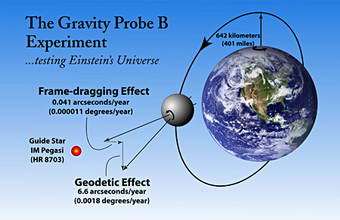
Launched on April 20, 2004, from Vandenberg Air Force Base, Calif., Gravity Probe B has been using four spherical gyroscopes to precisely measure two extraordinary effects predicted by Einstein's theory. One is the geodetic effect, the amount by which the Earth warps the local space time in which it resides. The other, called frame-dragging, is the amount by which the rotating Earth drags local space time around with it.
"We are proud to have been associated with this extremely significant mission," said Bob Schultz, Lockheed Martin's Gravity Probe B program manager. "Working with Stanford and NASA, we formed a powerful team to develop the challenging technologies needed to take a giant step forward in helping understand Einstein's theory of general relativity."
NASA's Marshall Space Flight Center, Huntsville, Ala., manages the Gravity Probe B program. Stanford conceived the experiment and is NASA's prime contractor for the mission. Stanford was responsible for the design and integration of the science instruments and mission operations. The university has the lead for data analysis. Lockheed Martin Space Systems Company designed, integrated and tested the space vehicle and built some major payload components.
For information about Gravity Probe B, visit: einstein.stanford.edu
Source: NASA


