World fire maps now available online in near-real time
May 24, 2006
World fire maps now available online in near-real time
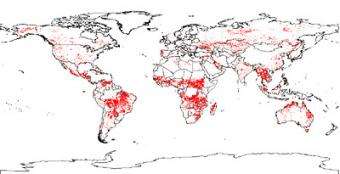
The ESA global detection of hot spots by ERS-2's Along Track Scanning Radiometer (ATSR-2) and Envisat's Advanced Along Track Scanning Radiometer (AATSR) in 2005. These twin radiometer sensors work like thermometers in the sky, measuring thermal infrared radiation to take the temperature of Earth's land surfaces. Temperatures exceeding 312º K (38.85 ºC) are classed as burning fires. Credits: ESA

For a decade now, ESA satellites have been continuously surveying fires burning across the Earth’s surface. Worldwide fire maps based on this data are now available to users online in near real time through ESA's ATSR World Fire Atlas.

The ATSR World Fire Atlas (WFA) – the first multi-year global fire atlas ever developed – provides data approximately six hours after acquisition and represents an important scientific resource because fire is a major agent of environmental change.
"The atlas is an excellent resource that provides a glimpse of the world that was not previously possible, and which is certain to allow ecologists to address both new and old questions regarding the role of fire in structuring the natural world," Matt Fitzpatrick of the University of Tennessee’s Department of Ecology & Evolutionary Biology said.

More than 50 million hectares of forest are burnt annually, and these fires have a significant impact on global atmospheric pollution, with biomass burning contributing to the global budgets of greenhouse gases, like carbon dioxide. In the past decade researchers have realised the importance of monitoring this cycle. In fact, WFA data are currently being accessed mostly for atmospheric studies.

Quantifying fire is important for the ongoing study of climate change. The 1998 El Niño, for example, helped encourage fires across Borneo which emitted up to 2.5 billion tonnes of carbon into the atmosphere, equivalent to Europe's entire carbon emissions that year.

There are over 200 registered users accessing the WFA. The data are being used in Europe, Asia, North America, South America, Africa and Australia for research in atmospheric chemistry, land use change, global change ecology, fire prevention and management and meteorology.

Harvard University, University of Toronto, National Centre for Atmosphere and NASA, among others, have used the data in research publications. To date, there are more than 100 scientific publications based on WFA data.

In addition to maps, the time, date, longitude and latitude of the hot spots are provided. The database covers 1995 to present, but complete yearly coverage begins from 1997.

The WFA data are based on results from the Along Track Scanning Radiometer (ATSR) on ESA’s ERS-2 satellite, launched in 1995, and the Advanced Along Track Scanning Radiometer (AATSR) on ESA’s Envisat satellite, launched in 2002.

These twin radiometer sensors work like thermometers in the sky, measuring thermal infrared radiation to take the temperature of Earth's land surfaces. Fires are detected best during local night, when the surrounding land is cooler.

Temperatures exceeding 312º K (38.85 ºC) are classed as burning fires by ATSR/AATSR, which are capable of detecting fires as small as gas flares from industrial sites because of their high temperature.

The WFA is an internal and Data User Programme (DUP) project.

Source: ESA

Explore further: Climate change and wildfire: Synthesis of recent findings

add to favorites email to friend print save as pdf

Related Stories

ESA satellite assesses damage of Norway's largest fire

Jun 27, 2008

Following the extremely hot weather conditions hitting Europe, Norway experienced its biggest forest fire in the last half century earlier this month. Envisat satellite images were used in the fire's aftermath to get an overview ...

European hot spots and fires identified from space

Aug 27, 2007

Hot spots across Southeastern Europe from 21 to 26 August have been detected with instruments aboard ESA satellites, which have been continuously surveying fires burning across the Earth’s surface for a ...

Floods and fires across Europe captured from space

Jul 27, 2007

Highlighting the extreme weather conditions hitting Europe, space sensors aboard ESA’s Envisat satellite have detected the worst floodwaters to hit Britain for 60 years and deadly fires raging through southern ...

Recommended for you

Climate change and wildfire: Synthesis of recent findings

7 hours ago

Concerns continue to grow about the effects of climate change on fire. Wildfires are expected to increase 50 percent across the United States under a changing climate, over 100 percent in areas of the West by 2050 as projected ...

Moore tornado a rarity, experts say

9 hours ago

Tornados, among the most violent of atmospheric storms, rarely reach the size and brutality of the twister that swept through an Oklahoma City suburb on Monday, experts say.

NGOs denounce Malaysia hydropower meeting

12 hours ago

Three dozen Malaysian NGOs on Tuesday denounced the world hydroelectric industry's decision to hold a conference in a Borneo state where dam projects have uprooted forests and native peoples.

User comments : 0

More news stories

Power of US tornado dwarfs Hiroshima bomb

Wind, humidity and rainfall combined precisely to create Monday's massive killer tornado in Oklahoma. The awesome amount of energy released dwarfed the power of the atomic bomb that leveled Hiroshima.

If you can remember it, you can remember it wrong

(Medical Xpress)—Native peoples in regions where cameras are uncommon sometimes react with caution when their picture is taken. The fear that something must have been stolen from them to create the photo ...

B vitamins could delay dementia

(Medical Xpress)—Despite spending billions of dollars on research and development, drug companies have been unable to come up with effective treatments for dementia and Alzheimer's Disease (AD). Now, A. ...

Reducing caloric intake delays nerve cell loss

Activating an enzyme known to play a role in the anti-aging benefits of calorie restriction delays the loss of brain cells and preserves cognitive function in mice, according to a study published in the May ...