If all drivers were polite, they would get where they're going faster
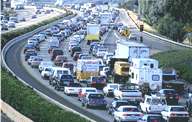
A new study from the University of Michigan found that traffic metering systems that incorporate new algorithms for merging could reduce the seriousness of traffic slowdowns that originate near freeway on-ramps.
Craig Davis, a retired Ford Motor Co. research scientist and current adjunct professor at U-M, studied highway merging to see how current on-ramp traffic meter systems could be made more effective. Currently, meter systems try to improve traffic flow by letting a certain number of cars enter the highway each minute based on how many cars are already there. Traffic metering has been around for a long time and many large U.S. cities have metering systems, Davis says.
Davis says there are two basic types of traffic congestion: gridlock-type jams where cars stop; and the synchronous flow-type congestion, where two or more lanes of traffic all slow down to the same speed. Synchronous flow happens often near on-ramps, when cars don't give one another enough room to merge, or when too many cars are on the road.
Metering systems use computer algorithms to try to predict when a jam may occur, typically based on occupancy. Davis, however, based his algorithm on the throughput and the rate at which vehicles are merging, not on highway occupancy. He found that traffic jams happen when throughput exceeds about 1,900 cars per hour per lane, and after that capacity drops by 10 percent or more.
Davis says in the absence of metering systems, simple politeness would go a long way toward thinning the sludgy traffic near on-ramps. But, letting people merge is helpful only if you don't slow down too much to do so.
"If you can do it without slowing down very much, that allows the driver who's entering to enter at a higher speed," Davis said. "If they have to crawl along waiting for an opening, they slow down the other vehicles on the freeway."
If you can safely move over a lane and allow a vehicle merge, that is even better, he adds.
Davis has received much attention for his research on automatic cruise control, a separate but related area of traffic congestion research. With ACC, onboard computers keep the correct distance between cars. Such systems have been shown in computer simulations to reduce traffic jams in throughput lanes, but don't do much to lessen the problem that is caused by merging near on-ramps, he says.
Source: University of Michigan


