May 17, 2006 feature
Electric field can align silver nanowires
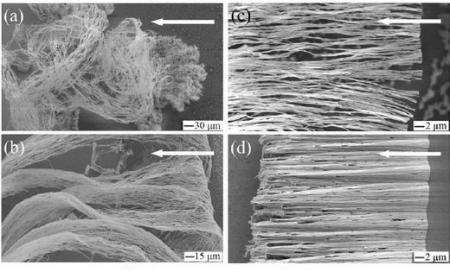
Scientists have discovered how to align silver nanowires in a controlled manner with an electric field. Their technique offers a possible route to sculpting and writing on nanowires, an ability that will likely have applications in industrial manufacturing.
Silver, one of the most precious metals for its shimmering beauty, also has the highest electrical conductivity of all metals. This property enabled a team of scientists from the Tsinghua University P.R. China to observe that a direct current electric field can align one-dimensional, 60 nm-diameter silver nanowires. The ability to control silver nanowire alignment will likely lead to the development of nanoelectronics as well as nanoscale photonic structures.
“This is the first time an electric field has been used to align silver nanowires,” Jialin Sun, coauthor of the paper recently published in Nanotechnology, told PhysOrg.com. “The high quality alignment of nanowires can help form optimal nanoscale optoelectronic devices with periodic structure.”
The electric field-alignment technique works because of the fact that the silver compound used by the scientists is a solid electrolyte at room temperature. As an electrolyte, silver ions can roam freely, and diverge from their crystalline lattices. So when the scientists applied an electric field, the disordered silver ions were free to align themselves under the field.
The study also found that the degree of alignment increased with an increase of the electric field strength. The series of images above, taken by a scanning electron microscope, shows the effect of progressive electric field strengths on a bundle of silver nanowires.
In the experiment, the silver ions tended to migrate along the direction of the current, causing the nanowires to “grow” parallel to the direction opposite the current. In the case of the strongest (400 V m-1) electric field, the nanowire bundle clustered into a dense, sheet-like structure. In fact, the nanowires actually became denser after the applied electric field, further enhancing their usability for nanoelectronics applications.
“The alignment of nanowires can be effectively controlled by adjusting the applied DCEF [direct current electric field] strength between the two electrodes, and improved by increasing the DCEF strength,” the scientists wrote.
In addition to the novelty, this method’s ease of preparation has smoothed the road toward prospective applications. Because the electric field-alignment technique can occur at room temperature, at normal atmospheric pressure and without any complicated and collapsible templates, the method has overcome many of the challenges of current approaches to nanowire alignment.
“It is believed that the synthesized alignment of metallic nanowires can be easily realized under normal conditions,” said Sun. “This technique will be very important for the process of industrial manufacturing. For example, this method can be used for the preparation of metallic nano-circuits, nanowire-grid polarizers, nanoscale photon crystals, nanoscale optical wave guides, and so on.”
The scientists also project that an electric field could “sculpt” nanowire structures, drawing lines and shapes with a scanning tunneling microscope.
Citation: Cao, Yang, et al. “A technique for controlling the alignment of silver nanowires with an electric field.” Nanotechnology 17 (2006) 2378-2380.
By Lisa Zyga, Copyright 2006 PhysOrg.com


