How Did Cactuses Evolve
May 15, 2006
Cactus

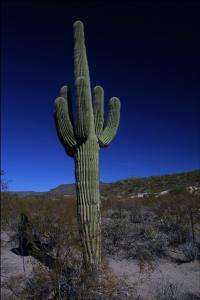
In a groundbreaking new study in the June issue of American Naturalist, Erika J. Edwards (Yale University and University of California, Santa Barbara) and Michael J. Donoghue (Yale University) explore how leafy, "normal" plants evolved into the leafless succulent cactus.

"The cactus form is often heralded as a striking example of the tight relationship between form and function in plants," write the authors. "A succulent, long-lived photosynthetic system allows cacti to survive periods of extreme drought while maintaining well-hydrated tissues."

Recent molecular phylogenetic work has confirmed that Pereskia, a genus that consists of 17 species of leafy shrubs and trees, is where the earliest cactus lineages began. Using field studies and environmental modeling, Edwards and Donoghue found that the Pereskia species already showed water use patterns that are similar to the leafless, stem-succulent cacti.

"[Our] analyses suggest that several key elements of cactus ecological function were established prior to the evolution of the cactus life form," explain the authors. "Such a sequence may be common in evolution, but it has rarely been documented as few studies have incorporated physiological, ecological, anatomical, and phylogenetic data."

Copyright 2006 by Space Daily, Distributed United Press International

Explore further: Front-row seats to climate change

add to favorites email to friend print save as pdf

Related Stories

Sacred lotus genome sequence enlightens scientists

May 10, 2013

The sacred lotus (Nelumbo nucifera) is a symbol of spiritual purity and longevity. Its seeds can survive up to 1,300 years, its petals and leaves repel grime and water, and its flowers generate heat to att ...

Chile's ALMA probes for origins of universe

Oct 26, 2012

(AP)—Earth's largest radio telescope is growing more powerful by the day on this remote plateau high above Chile's Atacama desert, where visitors often feel like they're planting the first human footprints ...

Restoration as science: case of the collared lizard

Aug 22, 2011

In a time when a five-year grant is considered a long-term grant, Alan R. Templeton, PhD, a professor of biology in Arts & Sciences at Washington University in St. Louis, has managed to follow some of the ...

Studying Genes of Desert Fruit Flies

Jun 19, 2007

Researchers at the University of Arkansas and University of Nevada-Las Vegas will study the genetics of fruit flies in desert habitats to determine how they developed the ability to survive under stressful ...

Recommended for you

Front-row seats to climate change

May 17, 2013

By day, insects provide the white noise of the South, but the night belongs to the amphibians. In a typical year, the Southern air hangs heavy from the humidity and the sounds of wildlife.

Climate change may have little impact on tropical lizards

May 17, 2013

A new Dartmouth College study finds human-caused climate change may have little impact on many species of tropical lizards, contradicting a host of recent studies that predict their widespread extinction in a rapidly warming ...

Wetlands: value to locals matters most

May 17, 2013

A new way of valuing ecosystem services, incorporating the local perspective, is the driving force behind a project assessing aquatic ecosystems in highland areas of Asia

User comments : 0

More news stories

Morocco to harness the wind in energy hunt

Morocco is ploughing ahead with a programme to boost wind energy production, particularly in the southern Tarfaya region, where Africa's largest wind farm is set to open in 2014.

US seizes Bitcoin operator accounts

US authorities seized the accounts of a Bitcoin digital currency exchange operator, claiming it was functioning as an "unlicensed money service business," court documents showed Friday.