Breathing Moonrocks
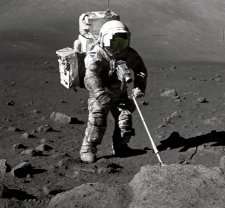
An early, persistent problem noted by Apollo astronauts on the Moon was dust. It got everywhere, including into their lungs. Oddly enough, that may be where future Moon explorers get their next breath of air: The moon's dusty layer of soil is nearly half oxygen. The trick is extracting it.
"All you have to do is vaporize the stuff," says Eric Cardiff of NASA's Goddard Space Flight Center. He leads one of several teams developing ways to provide astronauts oxygen they'll need on the Moon and Mars.
Lunar soil is rich in oxides. The most common is silicon dioxide (SiO2), "like beach sand," says Cardiff. Also plentiful are oxides of calcium (CaO), iron (FeO) and magnesium (MgO). Add up all the O's: 43% of the mass of lunar soil is oxygen.
Cardiff is working on a technique that heats lunar soils until they release oxygen. "It's a simple aspect of chemistry," he explains. "Any material crumbles into atoms if made hot enough." The technique is called vacuum pyrolysis -- pyro means "fire", lysis means "to separate."
"A number of factors make pyrolysis more attractive than other techniques," Cardiff explains. "It requires no raw materials to be brought from Earth, and you don't have to prospect for a particular mineral." Simply scoop up what's on the ground and apply the heat.
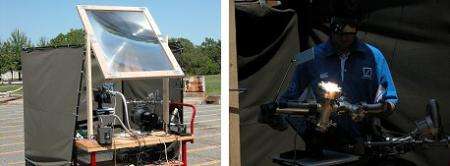
In a proof of principle, Cardiff and his team used a lens to focus sunlight into a tiny vacuum chamber and heated 10 grams of simulated lunar soil to about 2,500 degrees C. Test samples included ilmenite and Minnesota Lunar Simulant, or MLS-1a. Ilmenite is an iron/titanium ore that Earth and the Moon have in common. MLS-1a is made from billion-year-old basalt found on the north shore of Lake Superior and mixed with glass particles that simulate the composition of the lunar soil. Actual lunar soil is too highly prized for such research now.
In their tests, "as much as 20 percent of the simulated soil was converted to free oxygen," Cardiff estimates.
What's leftover is "slag," a low-oxygen, highly metallic, often glassy material. Cardiff is working with colleagues at NASA's Langley Research Center to figure out how to shape slag into useful products like radiation shielding, bricks, spare parts, or even pavement.
The next step: increase efficiency. "In May, we're going to run tests at lower temperatures, with harder vacuums." In a hard vacuum, he explains, oxygen can be extracted with less power. Cardiff's first test was at 1/1,000 Torr. That is 760,000 times thinner than sea level pressure on Earth (760 Torr). At 1 millionth of a Torr -- another thousand times thinner -- "the temperatures required are significantly reduced."
Cardiff is not alone in this quest. A team led by Mark Berggren of Pioneer Astronautics in Lakewood, CO, is working on a system that harvests oxygen by exposing lunar soil to carbon monoxide. In one demonstration they extracted 15 kg of oxygen from 100 kg of lunar simulant--an efficiency comparable to Cardiff's pyrolysis technique.
D.L. Grimmett of Pratt & Whitney Rocketdyne in Canoga Park, CA, is working on magma electrolysis. He melts MLS-1 at about 1,400 deg. C, so it is like magma from a volcano, and uses an electric current to free the oxygen.
Finally, NASA and the Florida Space Research Institute, through NASA's Centennial Challenge, are sponsoring MoonROx, the Moon Regolith Oxygen competition. A $250,000 prize goes to the team that can extract 5 kg of breathable oxygen from JSC-1 lunar simulant in just 8 hours.
The competition closes June 1, 2008, but the challenge of living on other planets will last for generations.
Got any hot ideas?
More information:
http://www.lpi.usra.edu/meetings/leag2005/pdf/2069.pdf
http://www.lpi.usra.edu/meetings/leag2005/pdf/2042.pdf
Source: Science@NASA, by Dave Dooling


