SSRL Aids Development of Plastic Electronics
May 04, 2006
SSRL Aids Development of Plastic Electronics
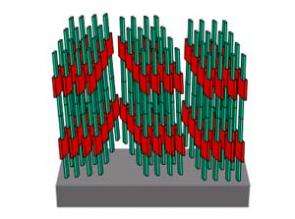
A plastic polymer conducts electricity much better when small crystals within the plastic polymer are aligned perpendicular to the surface. Image courtesy of Joe Kline, NIST

For close to a decade, researchers have been trying to improve the performance of plastic semiconductors to the level of amorphous silicon—the semiconductor used in low-cost electronics such as photovoltaic cells for solar power and thin-film transistors used in flat screen laptops and TVs.

Stanford Synchrotron Radiation Laboratory (SSRL) and Stanford University researchers have now shown that the electrical performance of plastic semiconductors can be controlled and improved with surface treatments. In their research, published in Nature Materials in March, they showed they could align the small crystals within the plastic polymer by applying a thin layer of organic molecules on to the surface. The highly-oriented crystals give the material better performance in conducting electricity. Researchers used x-ray scattering at SSRL to show the orientation of the crystals.

In a related paper, published in April's Nature Materials, Merck Chemicals in the United Kingdom developed a new polymer whose electrical mobility, related to conductivity, is the highest so far in a polymer, endowing the new polymer with performance comparable to amorphous silicon. SSRL, Stanford University and the Palo Alto Research Center characterized this new material, and found it has very highly-oriented crystals. "The structural properties of this new material are unprecedented for a polymer," said former Stanford graduate student Joe Kline, now a postdoctoral researcher at the National Institute of Standards and Technology.

Semiconducting polymers have many advantages over amorphous silicon: they are cheaper, faster and less energy-intensive to make; they can be dissolved in a solution and sprayed on, like ink from an inkjet printer; and they are flexible, an important trait for applications such as electronic paper.

Source: Stanford Linear Accelerator Center, by Heather Rock Woods

Explore further: Organic CMOS image sensor technology using organic photoelectric conversion layer

add to favorites email to friend print save as pdf

Related Stories

Snowden's life surrounded by spycraft (Update)

17 hours ago

In the suburbs edged by woods midway between Baltimore and Washington, residents long joked that the government spy shop next door was so ultra-secretive its initials stood for "No Such Agency." But when ...

Winners and losers at this week's E3

17 hours ago

Since the first battles over "Pong" machines in local arcades four decades ago, video gamers have loved good competition. And this year's Electronic Entertainment Expo—the industry's largest annual gathering—presented ...

Europe's space truck docks with ISS

17 hours ago

A robot freighter bearing 6.6 tonnes of cargo docked with the International Space Station (ISS) on Saturday, the European Space Agency (ESA) said.

Secret to Prism program: Even bigger data seizure

17 hours ago

In the months and early years after the Sept. 11, 2001, terrorist attacks, FBI agents began showing up at Microsoft Corp. more frequently than before, armed with court orders demanding information on customers.

New app helping Venezuelans find scarce items

Jun 09, 2013

Harried Venezuelans who devote hours scouring supermarkets for increasingly scarce food basics and toilet paper have just received some digital help thanks to a young software developer.

Recommended for you

Kim Dotcom slams Megaupload 'data massacre'

1 hour ago

Megaupload founder Kim Dotcom Thursday condemned a Dutch company's decision to delete million of files belonging to users of his defunct website, calling it "the largest data massacre in the history of the ...

US seizure of journalist records called 'chilling'

2 hours ago

The US government's secret seizure of Associated Press phone records had a "chilling effect" on newsgathering by the agency and other news organizations, AP's top executive said Wednesday.

Microsoft mulled buying Nokia unit

2 hours ago

Microsoft was in talks to boost its position in the mobile phone market by buying the devices business from Nokia but failed to seal a deal, the Wall Street Journal reported Wednesday.

User comments : 0

More news stories

Multiview 3-D photography made simple

Computational photography is the use of clever light-gathering tricks and sophisticated algorithms to extract more information from the visual environment than traditional cameras can.

Microsoft mulled buying Nokia unit

Microsoft was in talks to boost its position in the mobile phone market by buying the devices business from Nokia but failed to seal a deal, the Wall Street Journal reported Wednesday.