Biotech cotton provides same yield with fewer pesticides
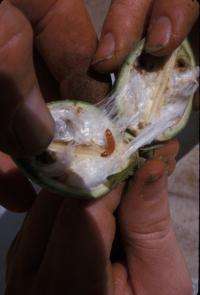
Arizona farmers receive the same yield/acre, use fewer chemical insecticides and maintain insect biodiversity when they plant the biotech cotton known as Bt cotton, according to new research.
The finding comes from the first large-scale study that simultaneously examined how growing Bt cotton affects yield, pesticide use and biodiversity.
It's good news for the environment.
"What we see is that it's positive here in Arizona -- no doubt about it," said Yves Carrière, an associate professor of entomology at The University of Arizona in Tucson. "We've reduced pesticide use in Arizona. We've wanted to do that for 25 years."
Bt cotton has been genetically altered to produce Bt toxin, a naturally occurring insecticide that kills pink bollworm, a major pest of cotton. Bt cotton has been planted in Arizona since 1996. Now more than half of the state's 256,000 acres of cotton fields are planted with the biotech plants.
Some have suggested that, in addition to killing the target pests, insecticide-containing crops like Bt cotton would also kill beneficial and non-target arthropods.
The new study found that Bt cotton, also known as transgenic cotton, does not affect the biodiversity of insects in cotton fields.
Carrière said, "There were lots of factors that affected biodiversity in this study. Transgenics were not one of them."
He and his colleagues based their findings on a two-year study of 81 commercial cotton fields in a region of Arizona that spans about 2,500 square miles (6,600 square kilometers). Much of the field and lab work was done by Manda G. Cattaneo as part of her master's research at UA. Cattaneo is now an extension entomologist at Texas A&M University in College Station.
The multidisciplinary team will publish their research in an upcoming issue of the Proceedings of the National Academy of Sciences. A complete list of authors is at the end of this release. The Environmental Protection Agency funded the research.
Bt cotton controls only one of Arizona's three major cotton pests. To control the other two pests, sweet potato whitefly (Bemisia tabaci) and the western tarnished plant bug (Lygus hesperus), growers use broad-spectrum insecticides and other types of insecticides known as insect growth regulators.
Carrière and his colleagues studied how Arizona farmers actually planted their crops and applied pesticides.
The researchers compared the yield and pesticide use for 40 fields of non-Bt cotton, 21 fields of Bt cotton and 20 fields of Bt cotton that was also herbicide-resistant.
In addition, each cotton field selected for the study was next to an uncultivated area. That allowed the researchers to compare ant and beetle biodiversity among the various cotton fields and the uncropped areas.
The team used Geographical Information Systems (GIS) and LANDSAT satellite imagery to map the fields and evaluate plant growth in the non-cultivated areas. Plant growth can affect the biodiversity of insects found in an area.
The researchers found that, per pesticide application, Bt cotton produced 9 percent more cotton/acre than non-Bt cotton. However, growers that planted Bt cotton used fewer applications of broad-spectrum insecticides. As a result, growers ended up with similar yields/acre regardless of the type of cotton grown. Carrière suggests that yields were similar across cotton types because the additional insecticide applications on the non-Bt fields cut down on the damage from whiteflies and western tarnished plant bugs.
To see what factors affected insect biodiversity in the cotton fields, the researchers used a type of statistical analysis called path analysis. Factors that affected biodiversity included the sandiness of the soil, use of broad-spectrum insecticides and insect growth regulators, number of cotton seeds planted per acre, and the amount and types of plants in the adjacent uncultivated areas.
The researchers found that the type of cotton had no effect on how much insect biodiversity was in a particular field.
"Yield, pesticides and effects on non-target organisms -- we must look at those all together to assess the environmental impacts of transgenics," Carrière said. "The take-home message is that transgenic crops are very promising for reducing the impact of agriculture, but we need to study how they're integrated into the way we do agriculture. It depends on how the producers react to the technology."
He added, "It's a problem that is ecologically complex. We cannot say, 'Because it's good in Arizona that it will necessarily be good somewhere else.' We need to study many systems carefully before we can generalize."
Source: University of Arizona


