Slow motion mergers in galaxy clusters provide conditions to transform spirals to smooth disks
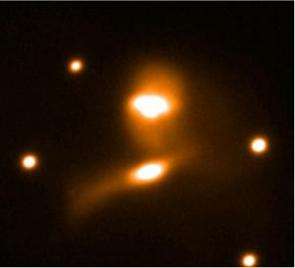
Astronomers at Liverpool John Moores University may have solved the mystery of how spiral galaxies in clusters are transformed over time into smooth disks. Results from a study of galaxy clusters confirms that the slow-motion conditions needed for the transformation are occurring among populations of galaxies falling towards the cluster centre.
Over the past several billion years the predominant shape of disc galaxies in clusters has changed from a spiral to a smooth disk. Theory suggests that this change occurs when two galaxies of unequal mass merge and gravitational effects pull gas to the galaxies nucleus, sweeping away the spiral structure and leaving behind a smooth, barren, thickened disk known as a lenticular galaxy.
However, galaxies orbiting in clusters move at high speeds and in random directions, which should mean that conditions needed for these slow interactions rarely occur. Instead, multiple rapid encounters between galaxies, known as 'galaxy harassment', are dominant but these types of fast encounters cannot easily form the smooth disks.
The group from Liverpool John Moores compared eight examples of populations of galaxies falling towards the centres of galaxy clusters with control samples of galaxies far from the clusters. They found that the infalling galaxies in the cluster were predominantly distorted in shape and had a higher than normal rates of star formation. Between a half and three-quarters of these galaxies were very close by to another galaxy or appeared to be merging with a companion galaxy, which suggested that interactions and mergers are more common in galaxies falling into the cluster than in the control sample.
"Our findings are very exciting because these results suggest that galaxies are more likely to merge when falling into a cluster and this may explain why clusters today have so few spirals and so many lenticular galaxies" said Dr Chris Moss, who will be presenting the results at the Royal Astronomical Society's National Astronomy Meeting on the 5th April.
The results suggest the conditions needed for slow galaxy interactions and mergers are more likely to occur in galaxies falling into a galaxy cluster compared to the general population of galaxies outside clusters.
Since infalling of galaxies into clusters was greater in the past, such interactions and mergers may have contributed significantly to the transformation of the past population of cluster spirals to lenticular galaxies in present-day clusters.
The observations were carried out over the past several years using the JKT (Jacobus Kapteyn Telescope) and the Nordic Optical telescope, La Palma based on earlier survey work using the Burrell Schmidt Telescope, Kitt Peak National Observatory.
Source: Royal Astronomical Society


