Scientist Creates Liquid Crystals with High Metal Content
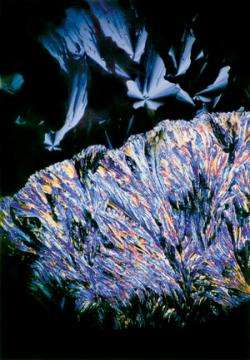
Researchers at North Carolina State University have successfully engineered liquid crystals that contain very high concentrations of metals – potentially paving the way toward the creation of “magnetic liquids” and liquid crystals that may have important ramifications for semi-conductor and solar energy research.
Dr. James Martin, professor of chemistry in NC State’s College of Physical and Mathematical Sciences, along with departmental colleague Dr. Jaap Folmer and a team of graduate students, engineered liquid crystals with an inorganic content of up to 80 percent, more than twice the ratio of previously observed organic liquid crystals with incorporated metals, or metallomesogens.
The findings appear in the April edition of Nature Materials.
Liquid crystals are prized for their unique optical and self-healing properties. They generally consist of toothpick- or pancake-shaped molecules that align in the liquid state because of their shape. By using electric fields to manipulate the orientation of liquid crystal molecules, scientists can control whether or not light can pass through the liquid crystalline material. Without such liquid crystals, everyday items we take for granted – such as flat-panel computer displays or LCD watches – would not exist.
The most commonly known liquid crystals are organic molecules composed of carbon,
nitrogen or oxygen. Adding inorganic materials, or metals, to these liquid crystals in order to potentially access electronic or magnetic properties was problematic because the structure of these molecules made it difficult to achieve a metallic concentration high enough to be useful.
Martin’s team recognized that to achieve high metal content in liquid crystals, it was necessary to start with an inorganic network from which liquid-crystalline molecules could be designed. They have achieved success with this strategy by using surfactants, like those in laundry detergent, to help engineer liquid crystalline structure from various inorganic networks. The ratios of surfactant and inorganic components used in preparation of these materials give the scientists a great deal of control over the structure of liquids.
The research could lead not only to the creation of new liquid crystals, but also to a new understanding of the ways in which all liquid structures – even membranes and proteins – are organized.
“Liquids are not random structures, but rather highly organized structures that we can control and shape at the atomic and molecular levels,” says Martin. “When we start exploring the ways in which we can organize these liquids, we can create totally new materials, and access different properties within each material.”
Source: North Carolina State University


