Gold nanoparticles can emit intense heat (Update)
Mar 31, 2006
Gold nanoparticles can emit intense heat
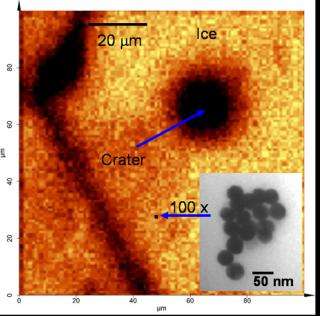
A cluster of gold nanoparticles 50 nanometers in diameter created a much larger crater in the ice sample, shown here. Courtesy of Hugh Richardson

Nanoparticles of gold can act as tiny, precise and powerful heaters, which potentially could be used in biomedical applications, according to a new study.

When stimulated with the right frequency of laser light, a small collection of metal nanoparticles, such as gold, can heat an area up to 1,000 times its size, according to Ohio University scientists Hugh Richardson and Sasha Govorov.

The heating properties were observed in ice, water and a polymer shell that was designed to mimic material in biological systems. Though the ice did not melt when heated by low-intensity laser alone, it dissolved once a gold nanoparticle was embedded, said the scientists, whose findings have been published online by the journal Nano Letters.

The gold particle is 50 nanometers, which is 200,000 times smaller than an object 1 centimeter in size, Govorov said.

The process not only generates a considerable amount of heat at much larger scale than the nanoparticle, but also is very precise, the researchers report. By using bio-linkers, the nanoparticles can be designed to affect specific targets. Bio-linkers are special, sticky molecules that are created to link with only certain types of cells. In a biomedical application, a few gold nanoparticles could be used to generate heat to impact a single macro-scale object, such as a tumor cell.

"What's amazing is that we're taking particles that you can't even image with a light microscope, and all of the sudden they cause a huge change in a macroscopic system," said Richardson, whose project was funded by Ohio University's NanoBioTechnology Initiative, one of three major research priorities of the institution.

The scientists will collaborate with other researchers to continue to test and design efficient nanoscale heaters in more complicated systems, such as in the cells from living organisms, Govorov said.

Richardson is a professor of chemistry and Govorov is an associate professor of theoretical physics at Ohio University. Other collaborators in the project include Zachary Hickman, Alyssa Thomas, Wei Zhang and Martin Kordesch, all of Ohio University.

Source: Ohio University

Explore further: Researchers perform fastest measurements ever made of ion channel proteins

add to favorites email to friend print save as pdf

Related Stories

Nanothermometers for cancer

Dec 01, 2005

Thermometers only nanometers or billionths of a meter in diameter could boost the effectiveness of heat- or cold-based anti-cancer therapies and optimize genetic analysis devices and electronics design, experts told UPI's ...

Recommended for you

Advance in nanotech gene sequencing technique

19 hours ago

(Phys.org) —The allure of personalized medicine has made new, more efficient ways of sequencing genes a top research priority. One promising technique involves reading DNA bases using changes in electrical ...

Engineers' nanoantennas improve infrared sensing

May 20, 2013

(Phys.org) —A team of University of Pennsylvania engineers has used a pattern of nanoantennas to develop a new way of turning infrared light into mechanical action, opening the door to more sensitive infrared ...

Kinks and curves at the nanoscale

May 19, 2013

One of the basic principles of nanotechnology is that when you make things extremely small—one nanometer is about five atoms wide, 100,000 times smaller than the diameter of a human hair—they are going ...

User comments : 0

More news stories

Advance in nanotech gene sequencing technique

(Phys.org) —The allure of personalized medicine has made new, more efficient ways of sequencing genes a top research priority. One promising technique involves reading DNA bases using changes in electrical ...

Making quantum encryption practical

One of the many promising applications of quantum mechanics in the information sciences is quantum key distribution (QKD), in which the counterintuitive behavior of quantum particles guarantees that no one can eavesdrop on ...

Evaluating a new way to open clogged arteries

Over the past few decades, scientists have developed many devices that can reopen clogged arteries, including angioplasty balloons and metallic stents. While generally effective, each of these treatments ...