September 6, 2005 feature
Silicon Nanotechnology to Combat Biowarfare Agents
In fall 2001, several letters containing deadly spores were sent to targeted spots across the county. The documents threatened the lives of postal workers, government administrative workers, officials and others. Countless other letters were sent which contained harmless white powder. At that time, swabbing for anthrax and sending the samples to the few labs that could test them took an excruciating amount of time - particularly for the people who were awaiting the results.
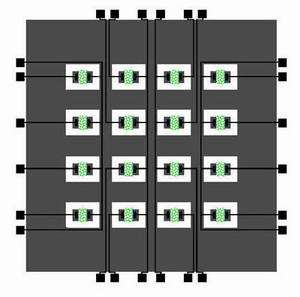
Image: Schematic of a fabricated 4X4 electrical biosensor array. (Courtesy of Infotonics Technology, Designed by Philippe Fauchet)
Researchers at the University of Rochester are developing a smart-system that would detect - and combat - the biowarfare agents. Research finds early detection and diagnosis is critical to ensure public safety and minimize the impact of agents such as anthrax. The biosensors will be able to function remotely inside buildings. The prototype development is a combination of nanoscience, nanotechnology and optics and fills an imminent national security need, researchers say.
Today, an upstate New York consortium of businesses; Eastman Kodak Co., Xerox Corp. and Corning Inc.; universities; and state and federal agencies such as the Department of Energy, the Department of Homeland Security and NASA is getting close to unveiling a prototype that could change the face of biowarfare detection going forward.
"Smart sensors are the key to detecting terrorist threats," said David R. Smith, Chief Executive Officer of Infotonics Technology Center in Canandaigua, New York. Infotonics is one of five centers of excellence across the state charged with making cutting-edge advances in fields such as nanotechnology.
Philippe Fauchet is the director of the University of Rochester's Center for Future Health. He leads a research team that is finding a fast, cost-effective method to test for agents like anthrax and plague.
According to Fauchet's proposal to Infotonics, the group is developing smart responsive sensors that will form a flexible portable platform capable of detecting and identifying the presence of multiple biological or chemical agents. The sensors will wander through buildings conducting a search. They will not only detect the agents but respond by releasing counteracting drugs. If the sensors can be mass-produced reliably and inexpensively, they would have a wide range of applications - from protecting at-risk personnel to monitoring water quality, Fauchet explained.
The key focus of the research is on transforming the sensors into microsystems that can be easily deployed and operated. The devices will be optimized for sensitivity, speed and specificity, Fauchet said. "Examples of these technologies include porous silicon electrical sensors containing pores ranging from a few nanometers to microns whose complex impedance responds in seconds to exposure to various targets each with a specific signature," Fauchet explained.
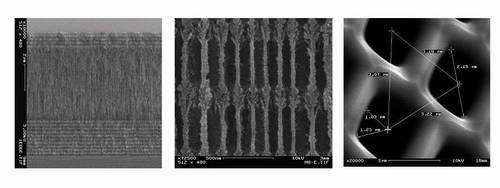
Image: Scanning electron micrographs of 1-D and 2-D photonic bandgap structures made of silicon and used in biosensing (Courtesy of Infotonics Technology, Designed by Philippe Fauchet)
Infotonics' chief Smith said the center - which has been up and running for 15 months - continues to work diligently to invest in Homeland Security research as one of its four initiatives. The others are: Biotechnology, Information and Communication and Defense and Aerospace.
At its inception, Infotonics invested in 13 projects worth a combined $4.5 million in an effort to take them through the euphemistic "valley of death" from the conceptual stage to the marketplace. One year later, executives are optimistic about the biowarfare detection sensors and the implications for future advances in technology that could make the country more secure.
"Philippe's work has been one of our most successful research investments," Smith marveled. "He's delivering really great stuff."
by Allison M. Cooper, Copyright 2005 PhysOrg.com


