Scientists weather a space storm to find its origin
Aug 02, 2005
SOHO

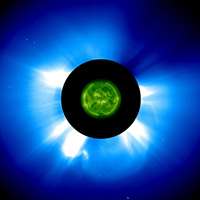
A team of researchers from the UK and France used SOHO, ACE and the four Cluster spacecraft to study a huge eruption on the Sun, tracing its progress from birth to when it reached Earth.

The team, led by scientists from University College London, identified the source of a ‘coronal mass ejection’ (CME) and analysed how its magnetic field changes on its path to Earth.
Triggered by a massive explosion on the Sun with millions of times more energy than a nuclear bomb, these CMEs are blasts of gas that could engulf Earth. CMEs are caused by the collision of loop-like magnetic field lines with different polarities on the Sun’s surface.

“There’s been much speculation about the shape of the magnetic field and how it might change on its journey from the Sun to Earth. Using complementary satellites we have been able to see that the magnetic field changes very little on its journey,” said Dr Louise Harra, of UCL Mullard Space Science Laboratory.

Earth’s magnetic field, forming the magnetosphere, protects the planet from the full brunt of these blasts, but when the CME’s fields collide directly with it they can excite geomagnetic storms. In extreme cases they cause electrical power outages and damage to communications networks and satellites.

“If we are to successfully predict storms we need to be able to identify an Earth-directed coronal mass ejection as it leaves the Sun and work out how it evolves,” said Dr Harra.

The CME was detected on 20 January 2004 by the ESA/NASA SOHO spacecraft which was used to identify the source of the ejection.

Two days later, on its journey to Earth, the ejected magnetic field passed ESA’s four Cluster spacecraft. Their tetrahedral formation allowed the sampling of the speed and direction of the field. Similar measurements were made by NASA’s ACE spacecraft.

“SOHO and Cluster spacecraft are ideally suited to working together - SOHO 'sees' the explosions from the Sun and Cluster 'feels' them. Our next step is to predict the eruption of storms on the Sun,” said Dr Harra.

This direct measurement by SOHO, ACE and Cluster confirms previous Earth-bound predictions and takes researchers a step closer to forecasting these geomagnetic storms.

Source: ESA

Explore further: Slovenian flyer lands in France on return trip from Arctic

add to favorites email to friend print save as pdf

Related Stories

NASA's BARREL mission launches 20 balloons

23 hours ago

(Phys.org) —In Antarctica in January, 2013 – the summer at the South Pole – scientists released 20 balloons, each eight stories tall, into the air to help answer an enduring space weather question: ...

NASA invites the public to fly along with Voyager

Apr 25, 2013

(Phys.org) —A gauge on the Voyager home page, http://voyager.jpl.nasa.gov, tracks levels of two of the three key signs scientists believe will appear when the spacecraft leave our solar neighborhood and ...

'Tis the season—for plasma changes at Saturn

May 03, 2013

(Phys.org) —A University of Iowa undergraduate student has discovered that a process occurring in Saturn's magnetosphere is linked to the planet's seasons and changes with them, a finding that helps clarify ...

GOES-R EXIS instrument ready for integration

May 02, 2013

The first of six instruments that will fly on GOES-R, NOAA's next-generation of geostationary operational environmental satellites, has been completed on schedule, seven months before its scheduled installation ...

Saturn to shed its spooky spokes for summer

Mar 13, 2013

As Saturn steadily moves along its 29.7-year-long orbit toward summertime in its northern hemisphere NASA's Cassini spacecraft is along for the ride, giving astronomers a front-row seat to seasonal changes ...

Recommended for you

Hubble reveals the ring nebula's true shape

10 hours ago

(Phys.org) —The Ring Nebula's distinctive shape makes it a popular illustration for astronomy books. But new observations by NASA's Hubble Space Telescope of the glowing gas shroud around an old, dying, ...

NASA head views progress on asteroid lasso mission

11 hours ago

Surrounded by engineers, NASA chief Charles Bolden inspected a prototype spacecraft engine that could power an audacious mission to lasso an asteroid and tow it closer to Earth for astronauts to explore.

Ecuador satellite collides with Russian space junk

11 hours ago

A small Ecuadoran satellite collided in orbit with the remains of a Russian rocket, but it is too soon to know how much damage it might have sustained, Quito's space agency said Thursday.

User comments : 0

More news stories

A hidden population of exotic neutron stars

(Phys.org) —Magnetars – the dense remains of dead stars that erupt sporadically with bursts of high-energy radiation - are some of the most extreme objects known in the Universe. A major campaign using ...

Hubble reveals the ring nebula's true shape

(Phys.org) —The Ring Nebula's distinctive shape makes it a popular illustration for astronomy books. But new observations by NASA's Hubble Space Telescope of the glowing gas shroud around an old, dying, ...

NASA head views progress on asteroid lasso mission

Surrounded by engineers, NASA chief Charles Bolden inspected a prototype spacecraft engine that could power an audacious mission to lasso an asteroid and tow it closer to Earth for astronauts to explore.

Controlling mood through the motions of mitochondria

(Medical Xpress)—Regulating the distribution of power in neurons is done by a system that makes the national electric grid look simple by comparison. Each neuron has several thousand mitochondria confined ...

A quantum simulator for magnetic materials

Physicists understand perfectly well why a fridge magnet sticks to certain metallic surfaces. But there are more exotic forms of magnetism whose properties remain unclear, despite decades of intense research. ...