Greatly Improved Solar Cells
Apr 21, 2004
PbSeNQD

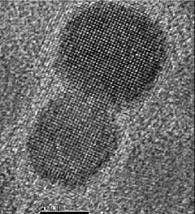
Victor Klimov and Richard Schaller at Los Alamos National Laboratory have enhanced the phenomenon called "impact ionization," which can significantly improve the efficiency of the conversion of solar energy to electrical current. Normally, an incident photon striking a semiconductor produces an electron-hole pair plus a bit of heat. By using sub-10-nm sized nanoparticles made of lead and selenium atoms, the Los Alamos scientists encourage the interaction to spawn a second exciton instead of the heat (see picture, which shows hi-resolution TEM image of epitaxially fused PbSe NanoQuantumDot pair.

Greatly improved solar cells might result from the use of a photophysical process in which for each incident solar photon not one but two excitons (electron-hole pairs) are created, says Physics News Update. As with photosynthesis what happens in a solar cell is the conversion of light energy into a small current of electrons; in plants the freed electrons helps to build glucose; in solar cells the currents are collected in the form of electricity.

Although they haven't yet built a working solar cell, they are the first to demonstrate the efficacy of getting the PbSe nanocrystals to render more photo-current. Implementing the new process might result in efficiency gains of more than 35% in the conversion of light to current. (Physical Review Letters, upcoming article)

See also the group website.


Explore further: Single-cell transfection tool enables added control for biological studies

add to favorites email to friend print save as pdf

Related Stories

Capturing light in an efficient dye trap

May 10, 2013

Chemical compounds that can efficiently capture and convert light energy are in high demand as key components of inexpensive solar cells and advanced optical sensors. Carbon-based organic dyes are particularly ...

Chaos proves superior to order

May 07, 2013

An international team of physicists, including researchers from the Universities of York and St. Andrews, has demonstrated that chaos can beat order - at least as far as light storage is concerned.

Recommended for you

Radioactive nanoparticles target cancer cells

2 hours ago

Cancers of all types become most deadly when they metastasize and spread tumors throughout the body. Once cancer has reached this stage, it becomes very difficult for doctors to locate and treat the numerous tumors that can ...

How gold nanoparticles can help fight ovarian cancer

4 hours ago

Positively charged gold nanoparticles are usually toxic to cells, but cancer cells somehow manage to avoid nanoparticle toxicity. Mayo Clinic researchers found out why, and determined how to make the nanoparticles effective ...

User comments : 0

More news stories

How gold nanoparticles can help fight ovarian cancer

Positively charged gold nanoparticles are usually toxic to cells, but cancer cells somehow manage to avoid nanoparticle toxicity. Mayo Clinic researchers found out why, and determined how to make the nanoparticles effective ...

Radioactive nanoparticles target cancer cells

Cancers of all types become most deadly when they metastasize and spread tumors throughout the body. Once cancer has reached this stage, it becomes very difficult for doctors to locate and treat the numerous tumors that can ...

New method for producing clean hydrogen

Duke University engineers have developed a novel method for producing clean hydrogen, which could prove essential to weaning society off of fossil fuels and their environmental implications.