Impact on Comet 9P/Tempel 1: Update, first European images
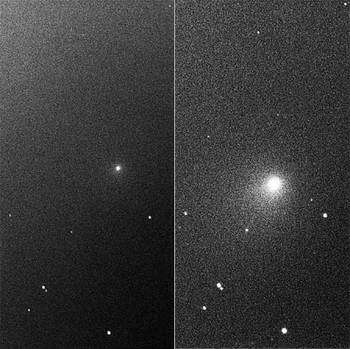
These are the first pictures of the impact received by European observers of the Deep Impact encounter.
They were taken by the Faulkes Telescope in Maui, Hawaii (Faulkes Telescope North), which was ideally placed to observe the impact which took place around 07:52 CEST on 4 July.
These images show impact and the flare growing as material is thrown out from the comet. The plume appears to be brightening the nucleus by a factor of approximately ten.
The Faulkes Telescope project owns two research quality telescopes, one on Maui and the other is located in Siding Spring, Australia (Faulkes Telescope South). Each telescope stands 8 metres tall and has a 2-metre diameter primary mirror and a field of view up to 30 arcminutes in diameter.
Deep Impact will provide a glimpse beneath the surface of a comet, where material from the solar system's formation remains relatively unchanged. Mission scientists expect the project will answer basic questions about the formation of the solar system, by offering a better look at the nature and composition of the frozen celestial travelers known as comets.
ESA's Director of Science, Professor David Southwood, offered his congratulations to NASA's Deep Impact team, on a successful mission to Comet 9P/Tempel-1.
The Deep Impact spacecraft has completed its first steps in exploring a comet's interior by creating a crater with an impactor spacecraft, allowing the mother spacecraft to look deep inside the comet during a fly-by immediately afterwards.
"The Deep Impact mission brought the world together in an excellent opportunity make a new step into the advancement of cometary science," said Prof. Southwood today.
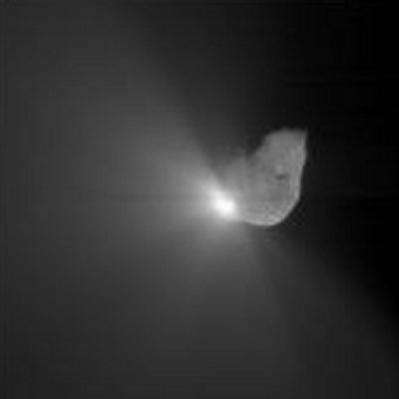
The medium-resolution camera on the NASA Deep Impact's fly-by spacecraft took this image just after 07:52 CEST on Monday, 4 July 2005, during the mission's encounter with Comet 9P/Tempel 1.
"The success of the Deep Impact mission will allowing us to use many space and ground observatories to look for the first time right inside a comet. As ESA, we are proud to be contributing to this campaign with some of our best sky-watchers - our Rosetta comet-chaser spacecraft, the XMM-Newton X-ray observatory, as well as Hubble Space Telescope (which we share with NASA) - and with ESA's Optical Ground Station in the Canary Islands. The results are going to be a terrific help in planning Rosetta's comet landing a decade from now."
New data and results on Tempel 1 and the impact will continue to be received in the next hours and days. Follow us while we continue to cover one of the world's largest astronomical observation campaigns, which includes ESA and NASA spacecraft, European observatories and many co-operating organisations around the world.
Source: ESA


