Volume Production Technology of HD DVD-R Discs Established
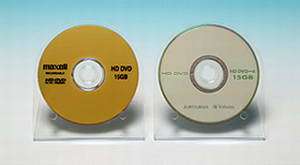
A group of four manufacturers today announced successful development of a prototype of a HD DVD-R disc, the write-once next generation DVD disc, that can be easily produced at high volume on standard DVD-Recordable production lines. Hitachi Maxell and Mitsubishi Kagaku Media/Verbatim, two of Japan's leading manufacturers of optical disc media, have separately tested and verified the manufacturability of the write-once discs, which use a new organic dye specifically developed for blue-laser applications, and confirmed the prospect of volume production. The new dye is the result of a joint development project by Hayashibara Biochemical Laboratories, a key manufacturer of dyes for DVD-Recordable discs, Mitsubishi Kagaku Media/Verbatim and Toshiba Corporation.
Hitachi Maxell and Mitsubishi Kagaku Media/Verbatim will commercialize HD DVD-R discs in spring next year, at the same time as the launch of HD DVD recorders and PCs with built-in HD DVD drives by hardware manufacturers, including Toshiba.
Development of the new dye by Hayashibara, Mitsubishi Kagaku Media/Verbatim and Toshiba is a breakthrough for HD DVD-R. Standard DVD-Recordable discs use a photosensitive organic dye as the data storage medium in their recording layer. In the transition to HD DVD, manufacturers had to meet the challenge of developing a dye for HD DVD-R discs that could be used with the narrow wavelength of a blue laser and offered sufficient readout stability. The newly developed organic dye is highly sensitive to blue laser light, has the uncompromised readout stability essential for practical use, and the solubility in organic solvent required for easy production of the dye recording layer by a spin-coating process. As the HD DVD-R disc is based on the same disc structure as DVD discs, back-to-back bonding of two 0.6 millimeter-thick substrates, already installed DVD-Recordable manufacturing lines can utilize the new dye in efficient production of HD DVD-R.
Hitachi Maxell and Mitsubishi Kagaku Media/Verbatim have both used the new dye in trial production of prototype HD DVD-R discs (single-layer, 15 gigabytes*) on their current DVD-Recordable production lines, and confirmed that the process can be applied to mass production.
"By combining our cumulative know-how in high-density optical disc technology with the breakthrough of the new dye, we have tested and proven the manufacturability of HD DVD-R discs," said Norio Ota, Executive Officer and General Manager of Development and Technology Division, Hitachi Maxell. "We will prepare for mass production of HD DVD-R on our current lines, in readiness for market growth in applications including HD DVD recorders and PCs with HD DVD drives."
Hidemi Yoshida, Chief Technology Officer of Mitsubishi Kagaku Media said, "As a disc manufacturer involved in development of the next generation HD DVD discs right from the beginning, Mitsubishi Kagaku is delighted to confirm the feasibility of production of dye-based HD DVD-R. DVD-Recordable has grown to be a major market, and we expect to see the same substantial growth in demand for HD DVD-R. We will prepare for mass production to support the forthcoming launch of HD DVD products."
"We are delighted to contribute to expanding the capabilities of the next generation HD DVD format through the successful development of the new dye in cooperation with the partner companies," said Yasuhiro Kotani, Corporate Director of Hayashibara Biochemical Laboratories. "In chemicals, where we focus our R&D efforts on functional dyes, our company will continue to develop and provide new dyes based on market requirements."
"I am delighted that the four companies, through their joint work, have proven the manufacturability of an HD DVD-R disc. HD DVD's basic feature of sharing the same disc structure as DVD made a large contribution to this success, and offers more and compelling evidence of our design policy's validity," said Hisashi Yamada, Chief Fellow of Toshiba's Digital Media Network Company. "In 2004 the recordable and rewritable DVD disc market stood at around 1.4 billion discs, and about ninety percent of those discs were write-once discs. The next generation write-once HD DVD disc will be just as important, and I am sure that proving an efficient mass production technology for HD DVD-R discs will provide a big boost for a smooth transition from DVD to HD DVD."
(*) Capacity of a disc is calculated with a basis of 1-gigabyte (GB) = 1-billion bytes.


