GALEX catches flashers and streakers in the ultraviolet sky
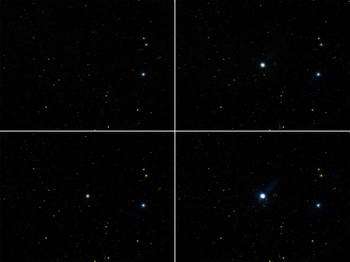
In the 18 months since its launch by NASA, the Galaxy Evolution Explorer (GALEX) ultraviolet space telescope has discovered a wealth of objects in the sky, from flaring dwarf stars to space debris streaking through the telescope's field of view.
Image: The star GJ 3685A just happened to be in the Galaxy Evolution Explorer's field of view while the telescope was busy observing galaxies. The seemingly serene star suddenly exploded once, then even more intensely a second time, pouring out in total about one million times more energy than a typical flare from our Sun. The second blast of light constituted an increase in brightness by a factor of at least 10,000.
Photo courtesy of NASA/JPL-Caltech.
"We had no idea that the ultraviolet sky would be filled with so many things that go bump in the night," said Barry Welsh, a researcher at the University of California, Berkeley's Space Sciences Laboratory and co-discoverer of some of the flares. "All of these objects are a bonus to astronomers, since the observations come free when the telescope is aimed at distant galaxies."
The telescope, launched April 28, 2003, was originally designed to spot galaxies in an attempt to map the history and evolution of the universe up to 80 percent of the way back to the Big Bang. In addition, however, it has repeatedly witnessed a sky flickering with ultraviolet flares, bursts and fast-moving streaks. While the flares and bursts are from different types of stars, the streaks are asteroids, satellites or possibly space debris floating across the telescope's field of view.
The findings have led astronomers to conclude that the ultraviolet sky, once thought to be a quiet backdrop for viewing galaxies, is, in fact, a rather festive place.
"I was surprised by how often we have observed stellar flares and by the amazing size of some of them," said GALEX principal investigator Chris Martin of the California Institute of Technology in Pasadena. "Nature rarely disappoints us."
One such flare flashed from the star GJ 3685A at 2 p.m. Pacific time on April 24, 2004, nearly overloading GALEX's detectors when the star abruptly brightened by a factor of at least 10,000. After the excitement was over, astronomers realized that they had just recorded a giant star eruption, or flare, about 1 million times more energetic than those from our sun.
Welsh presented data on the GALEX flare observations and analysis today (Tuesday, May 31) at the 206th meeting of the American Astronomical Society in Minneapolis, Minn.
So far, GALEX has recorded 84 bonus astrophysical events occurring on flaring stars, binary stars called dwarf novae and pulsating stars, as well as countless pieces of space debris. These data are already being collected in public databases for others to study. For example, astronomers are using the new set of flare stars to test their flare theories.
GALEX is surveying the entire sky at ultraviolet wavelengths for clues to how the earliest galaxies evolved into mature galaxies like our own Milky Way. To detect these early, faint galaxies, the telescope was outfitted with specialized cameras that allow the arrival of each photon of ultraviolet light to be timed with a precision of about a microsecond.
"The telescope's detectors have provided an unprecedented time resolution of these astrophysical events," said Welsh. "Now, we can say what happens during each one-hundredth of a second of a flare event. That's better information than most video cameras have when they take slow motion shots of athletes."
A preliminary analysis of the enormous flare witnessed by GALEX around GJ 3685A - the largest ever recorded in ultraviolet light - shows that the mechanisms underlying these stellar eruptions may be more complex than previously believed. Evidence for both of the two most popular flare theories was found.
Flares are huge explosions of energy stemming from a single location on a star's surface. They happen regularly on many types of stars, though old, small "red dwarf" stars (so-called M dwarfs) like GJ 3685A tend to experience them more frequently and more dramatically. These stars, called flare stars, can erupt as often as every few hours, and with an intensity far greater than flares from our sun. One of the reasons astronomers study flare stars is to gain a better picture and history of flare events taking place on the sun.
"These stars have very strong magnetic fields, so they are prone to flaring," Welsh said. "But no one has the telescope time to watch them until they go off. We were really lucky to get this."
Welsh is mining the GALEX data to determine the rate of flaring in M dwarf flare stars, which may tell astronomers something about the evolution and behavior of stars like our own.
Caltech leads the Galaxy Evolution Explorer mission and is responsible for science operations and data analysis. NASA's Jet Propulsion Laboratory in Pasadena, Calif., manages the mission and built the science instrument. The mission was developed under NASA's Explorers Program managed by the Goddard Space Flight Center in Greenbelt, Md. South Korea and France are the international partners in the mission.
Links:
GALEX Home page
View Movie


