World’s Most Precise 'Hard X-Ray' Nanoprobe Activated
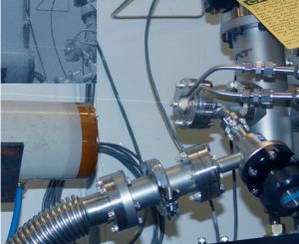
Marking a major step forward in using X-rays to study some of the smallest phenomena in nature, the world’s first “hard X-ray” nanoprobe beamline was activated on March 15, 2005. The unique nanoprobe is one of the featured instruments at the new Center for Nanoscale Materials (CNM), a U.S. Department of Energy (DOE) user facility at Argonne National Laboratory. CNM researchers expect to soon be using the X-ray nanoprobe to study individual atoms, molecules, and the unique physical interactions that occur at the nanoscale, where features are measured in nanometers.
Image: X-rays from an APS undulator exiting the front end window of the nanoprobe beamline. Ionized air highlights the path of the beam.
The CNM’s x-ray nanoprobe beamline uses the world’s brightest X-rays, called “hard” X-rays, from Argonne’s Advanced Photon Source (APS). Hard X-rays can better penetrate deep inside matter and allow scientists to investigate the world around us at the scale of individual atoms and molecules. They are a perfect tool for unraveling tough questions about the strange things that occur at the nanometer scale, where materials behave very differently than do conventional materials, and the traditional laws of physics do not apply. At the nanoscale, the principles of temperature, electricity and magnetism are completely different, which makes the basic scientific research to be conducted using the CNM’s X-ray nanoprobe so important before commercial products and materials can be developed.
CNM’s X-ray nanoprobe will have a spatial resolution of 30 nanometers or better, the highest of any hard X-ray microscopy beamline in the world. It will offer fluorescence, diffraction, and transmission imaging in the spectral range of 3-30 keV, making it a valuable tool for studying nanomaterials and nanostructures, as well as embedded structures.
CNM facilities and research programs are accessible to independent researchers through a peer-reviewed proposal process. The CNM welcomes discussions of potential proposals, especially those exploring novel applications of our capabilities or involving more than one area of research. The next proposal deadline is June 15, 2005.
Source: Argonne National Lab


