What Goes On Underneath Your Feet? Virtual Trip Inside The Earth
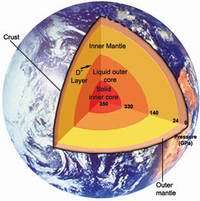
It is generally assumed that heat from Earth’s core and mantle, due to the low thermal conductivity of the latter, is transferred to the outer part mainly by convection. This implies swirling movement of an immense amount of hot material, which is behind the dynamics of Earth’s interior. Understanding the details of this is of great interest since it can explain natural phenomena such as earthquakes, volcanoes, movements of tectonic plates and formation of mountains. A team from the University of Paris and the European Synchrotron Radiation Facility (ESRF) have found out that iron-bearing magnesium silicate perovskite, the Earth’s most abundant mineral, transforms, when pressure is applied, to a state where radiation could play a far more important role in heat transfer in the lowermost part of the mantle. This would change our vision of the dynamics of the deep Earth and would suggest that the material at these depths is more static than currently thought.
These results are published today in 'Science'. They are based on experiments conducted at the ESRF, which, in addition to its high quality X-ray beam, allowed the conditions inside the Earth to be reproduced on the sample.
Earth’s lower mantle is formed mainly by two components: magnesium silicate perovskite and magnesiowüstite. The first one, the subject material of this research, occupies 80% of the mantle. Therefore, it is indispensable to explore how this behaves at high pressure. Iron in perovskite is in a magnetic (high-spin) state at atmospheric pressure, the electronic properties of which are mainly responsible for this mineral being opaque to infrared radiation (heat). The team performed the experiment at various pressures and found electronic transitions which show that iron becomes non-magnetic (low-spin) at significantly lower pressure than previously thought. This pressure (or depth) is consistent with that of the D" layer, the deepest part of the lower mantle which is also the most mysterious and uncharacterised layer in the Earth, which separates Earth’s liquid metallic core below from the solid silicate mantle above.
The most striking consequence of the revealed electronic transition is an increased transparency of the material to the near-infrared radiation (where the core and mantle radiate most of their thermal energy). The sample became more transparent to heat above 70 GPa (bottom third of the mantle) and almost completely transparent above 120 GPa (D? layer above the core-mantle boundary); this is more than one million times greater than atmospheric pressure. Increased transparency is the reason why these researchers suggest that in the deep Earth, radiation plays a larger role with respect to convection in transferring heat.
During the experiment, the researchers took a virtual trip inside the Earth by reproducing the conditions of Earth’s mantle at the ESRF. They placed the sample of iron-bearing perovskite between the two diamond tips of a diamond-anvil cell and subjected them to pressures from 20 to 145 GPa. By using x-rays, they could extract information from the sample and its behaviour under those conditions.
Source: ESRF


