Microwires: replacement for the CD-ROM?
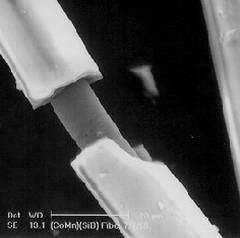
A ballpoint that detects if we are forging a signature or a substitute in miniature for the CD-ROM are some of the applications that can be carried out using microwires.
3 or 5 times thinner than a human hair, these fine threads were invented in the old Soviet Union for military purposes but, the broader scientific community has been studying them for some time now for other applications – including at the University of the Basque Country (EHU).
[Editor's note: there are several confusions in this article: "byte" --> "bit" and "Gb" --> "Mb"]
Body and coating
Microwires have a metal body and a glass coating. The size of the metal body is usually about 1-20 μm radius and the glass coating of between 5 and 20 μm thickness Being so fine, the microthreads are totally flexible.
The main body of the microwire made of a ferromagnetic alloy, the composition of which varies depending on the metals used in the alloy and on the final dimensions of the thread. As a result, by balancing these two factors, the range of microwires that can be obtained is very wide. But there is one quality that they all have: they all have magnetic properties. It is precisely these magnetic properties and their diminutive size that make them so appreciated.
10 Gigabytes in 10 cm long
Amongst all the possible applications, the research team at the EHU has launched a similar project for using microwires as a system for storing information. The microwires become diminutive substitutes for the CD-ROM, given that information can be stored magnetically on them, as with CDs.
To do this, researchers use a magnetic properties present in certain microwires: the magnetic bistability associated with a circular, "bamboo"-type structure of domains. This structure presents positive and negative magnetising orientations at the surface of the microwire when this is subjected to a magnetic field, i.e. the microwire becomes magnetised. As a result, the two orientations of the magnetisation at the surface can be interpreted as the 1 and the 0 of a digital system (respectively positive and negative).
Taking this property into account, in order to create the replacement for the CD-ROM, the microwire has to be divided up along its length. Of course, the thread cannot be sectioned – the divisions are carried out internally by means of a process of anisotrophy.
The researchers calculate that a 10 cm long microwire can carry out 10 million divisions or cells and in each one of these a byte can be stored. In order to store the byte, each one of these cells is magnetised in one orientation or the other.
Once the information is recorded, a system for retrieving and reading it has to be devised. But the reading is not immediate. The initial response of the reading is an electrical signal which has to be amplified and processed in an appropriate manner in order to access the real information.
These are the targets of this project – but, of course, it is no easy task. The greatest difficulty it seems will be with the reading of information; i.e. the achievement of an electrical signal sufficiently suitable to be converted subsequently into a digital one.
Source: Elhuyar Fundazioa


