Mars Reconnaissance Orbiter Mission
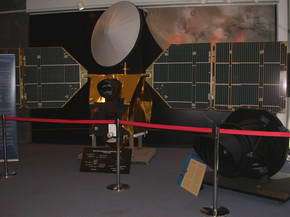
Even as the Spirit and Opportunity rovers complete a year of successful operation on Mars, the next major step in Mars Exploration is taking shape with preparation of NASA's Mars Reconnaissance Orbiter for launch in just seven months.
Image: A half-scale model of Mars Reconnaissance Orbiter shows the high-gain antenna at the top. To the sides are the solar panels; below the antenna are the scientific instruments. Image credit: NASA/JPL
The orbiter is undergoing environmental tests in facilities at Lockheed Martin Space Systems in Denver, Colo., where its Atlas V launch vehicle is also being prepared. Developments are on schedule for a launch window that begins on Aug. 10.
"The development teams from JPL, Lockheed Martin and the various institutions providing flight instruments have been working hard and efficiently as a team. Everything has really come together in the last couple of months," said Mars Reconnaissance Orbiter Project Manager Jim Graf of NASA's Jet Propulsion Laboratory, Pasadena, Calif. "The schedule remains tight, even as we continue to meet our major milestones in preparation for a late summer launch. And I am really excited about what this spacecraft, this team and these instruments can do once we get to Mars. The spacecraft engineering bus and the science instruments will be the most capable ever sent to another planet. The science gleaned from this mission will dramatically expand our understanding of Mars."
The Mars Reconnaissance Orbiter carries six primary instruments: the High Resolution Imaging Science Experiment, Context Camera, Mars Color Imager, Compact Reconnaissance Imaging Spectrometer for Mars, Mars Climate Sounder and Shallow Radar. All but the imaging spectrometer are currently onboard. That instrument is the last of several that had been installed but were removed so the science teams could replace an electrical component. It will be re-delivered this month. The orbiter will also carry a telecommunications relay package and two engineering demonstrations.
"We're moving at a robust pace in the testing phase now and we're right on track for getting the spacecraft ready to ship to Florida this spring," said Kevin McNeill, Mars Reconnaissance Orbiter program manager at Lockheed Martin Space Systems. "Mars Reconnaissance Orbiter has been a great spacecraft to work on, in part because we used an 'open structure' design that allows our engineers and the science teams to work in and around the spacecraft during every phase of integration and testing, with even greater ease and accessibility than we've had on previous missions. In many respects, the open design has facilitated the integration and testing of the spacecraft. We'll be in the final phase of testing during the next four months. Then, it's off to Florida."
Located just a few buildings away from where the spacecraft is undergoing tests at Lockheed Martin's facilities near Denver, the company also is building the mission's Atlas V launch vehicle. The Atlas V, designated AV-007, will launch Mars Reconnaissance Orbiter in August from Cape Canaveral Air Force Station, Florida. The Atlas is undergoing final assembly and testing, and will be shipped to Cape Canaveral in March to be readied for launch.
Less than two years from now, the Mars Reconnaissance Orbiter will begin a series of global mapping, regional survey and targeted observations from a near-polar, low-altitude Mars orbit. These observations will be unprecedented in terms of the spatial resolution and coverage achieved by the orbiter's instruments as they observe the atmosphere and surface of Mars while probing its shallow subsurface as part of a "follow the water" strategy.
JPL's Dr. Rich Zurek, project scientist for the Mars Reconnaissance Orbiter, said, "The major discoveries by the Mars Exploration Rovers at the Meridiani and Gusev Crater locales indicate that water did persist on the surface of the planet for some time, so a 'follow the water' strategy is appropriate. However, the rovers have explored just two very small areas of the planet. A goal of this mission is to find many, many locales where water was active on the surface for extended periods and thereby provide a suite of sites for future landers to explore where the potential for further discovery is high and the risk of encountering surface hazards is low."
Source: NASA


