World's Largest 21-inch OLED for TVs from Samsung
Jan 04, 2005
World's Largest 21-inch OLED for TVs from Samsung

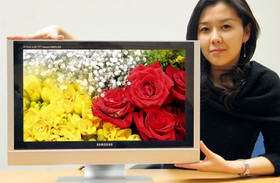
Samsung Electronics, the leader in TFT-LCD technology, announced today that it developed the largest single-panel active matrix-based (AM) Organic Light-Emitting Diode (OLED) display.
At 21-inches, this OLED features the highest resolution at 6.22 million pixels (WUXGA: wide ultra-extended graphics array). In addition, the company adopted AM-based technology for its low power consumption and high-resolution qualities.

An organic light-emitting diode (OLED) is a light-emitting diode (LED) made of semiconducting organic polymers. These devices promise to be much cheaper to fabricate than inorganic LEDs. Varying amounts of OLEDs can be deposited in arrays on a screen using simple "printing" methods to create a graphical colour display, for use as television screens, computer displays, portable system screens, and in advertising and information board applications. OLED panels may also be used as lighting devices. OLEDs are available as distributed sources while the inorganic LEDs are point sources of light. Prior to standardization, OLED technology was also referred to as OEL or Organic Electro-Luminescence.

One of the great benefits of an OLED display over the traditional LCD displays found in computer displays is that OLED displays don't require a backlight to function. This means that they draw far less power and they can be used with small portable devices which have mostly been using monochrome low-resolution displays to conserve power. This will also mean that they will be able to last for long periods of time with the same amount of battery charge.

Samsung's new OLED offers brightness of 400 nit, contrast ratio of 5000:1, color gamut of 75 percent and fast response times, making the product ideal for viewing HD-resolution video images.

Moreover, the OLED uses Amorphous Silicon (a-Si) technology; thus can be mass-produced within Samsung's existing TFT-LCD lines. Samsung Electronics has now applied the a-Si technology to produce large-sized OLED panels within 4th and 5th generation production lines.

"With the development of the world's largest OLED at WUXGA resolution, Samsung has achieved a technological advantage and is positioned well to be a leader in the large-sized OLED for the TV market," said Jun-Hyung Souk, senior vice president of the LCD R&D Center.

Explore further: Congress gets mixed advice on regulating drones

add to favorites email to friend print save as pdf

Related Stories

Quantum dot LED approaches theoretical maximum efficiency

May 14, 2013

(Phys.org) —Quantum dot LEDs (QLEDs) are a promising technology for creating large-area displays that could have applications for TVs, cell phones, and digital cameras. So far, however, the highest efficiencies ...

TVs get bigger, bolder, smarter at CES show (Update)

Jan 08, 2013

TV makers showing off their new wares at a huge trade fair will seek to dazzle consumers with bigger, bolder displays, and smarter technologies for consumers who want television to be a "multiscreen" experience.

Recommended for you

Congress gets mixed advice on regulating drones

May 17, 2013

(AP)—The growing use of unmanned surveillance "eyes in the sky" aircraft raises a thicket of privacy concerns, but the U.S. Congress is getting mixed advice on what, if anything, to do about it.

Makr Shakr uses three arms for drink-recipe collabs

May 15, 2013

(Phys.org) —We're told it's the wave of the future. Design, make, enjoy. Beyond home-based 3-D printers, there will be new machines and display screens and apps that will invite you to have day to day products ...

Nokia unveils metallic smartphone, stock tumbles (Update)

May 14, 2013

Nokia Corp. on Tuesday unveiled its first Lumia smartphone with a metal cover, low-light camera features and new social network apps. But the new model failed to impress investors, who sent the company's stock down more than ...

User comments : 0

More news stories

Congress gets mixed advice on regulating drones

(AP)—The growing use of unmanned surveillance "eyes in the sky" aircraft raises a thicket of privacy concerns, but the U.S. Congress is getting mixed advice on what, if anything, to do about it.

Makr Shakr uses three arms for drink-recipe collabs

(Phys.org) —We're told it's the wave of the future. Design, make, enjoy. Beyond home-based 3-D printers, there will be new machines and display screens and apps that will invite you to have day to day products ...

RIM unveils cheaper BlackBerry (Update 2)

Research In Motion unveiled a lower-cost BlackBerry aimed at consumers in emerging markets on Tuesday, and said it will offer its once-popular BlackBerry Messenger service on iPhones and devices running Google's ...

Why we need to put the fish back into fisheries

Overfishing has reduced fish populations and biodiversity across much of the world's oceans. In response, fisheries are increasingly reliant on a handful of highly valuable shellfish. However, new research by the University ...