Female Cantabrian bears and their young do not hibernate
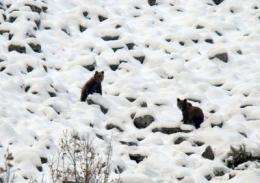
A team of Spanish scientists followed the brown bear population through the mountains of the Cantabrian Cordillera between 1998 and 2007 in order to find out about their hibernation habits, which had been questioned in historical documents. The results confirm that female bears with babies and independent young bears under the age of two do not usually hibernate, while the other bears follow normal hibernation patterns.
Brown bears (Ursus arctos) all over the world hibernate, but according to historical documents this is not always the case. The Libro de la Montería by King Alfonso XI, dating back to the 14th Century, mentions that female bears with young born during the previous year did not go to sleep in the winter, or at least not all of them. We have had to wait more than 400 years for new observations to demonstrate this phenomenon among two bear populations (east and west) in the Cordillera Cantábrica mountain chain.
"During our monitoring of female bears with young, which we did in the east of the Cordillera Cantábrica on the basis of footprints and tracks, we saw that some animals stayed active throughout the whole winter", Carlos Nores, lead author of the study and a researcher at the Natural Resources and Zoning Institute (INDUROT) of the University of Oviedo (UNIOVI) and vice president of the Brown Bear Foundation, tells SINC.
The study, which has been published in the journal Acta Theriologica, covers the period from 1998 to 2007, during which time female bears with young were monitored between December and March. "The winter track count showed that female bears with young cubs aged between 11 and 14 months show signs of continuous activity, as do young bears of two years of age that are starting to become independent, although they do hibernate more than when they were in the family group", says Nores.
The scientists showed that the seven family groups in the two bear populations did not stop eating or defecating over the period of observation, confirming that "they did not enter the physiological state of hibernation at any time", the biologist explains.
According to the researchers, the absence of hibernation seen in the Cordillera Cantábrica mountains "has nothing to do with the harshness of the weather conditions, or snow levels being above or below average".
Without young, bears hibernate
The other bears aged over two years old, including females about to give birth or without any young to care for, exhibited "a significant reduction in activity between January and February, corresponding with predictable hibernation behaviour", the Asturian researcher points out.
However, while counting footprints over the course of a decade has made it possible to prove habitual wintertime activity among family groups and young, recently-independent bears in the Cordillera Cantábrica, "it does not prove that they are truly not hibernating", says Nores.
"Bears may occasionally leave their caves during hibernation, but during true hibernation they do not eat, drink or defecate, although they may do so sporadically", the scientist says.
More information: Nores, Carlos; Ballesteros, Fernando; Blanco, Juan C.; García-Serrano, Alicia; Herrero, Juan; Palomero, Guillermo. "Evidence of non-hibernation in Cantabrian brown bears" Acta Theriologica 55(3): 203-209, July 2010.
Provided by FECYT - Spanish Foundation for Science and Technology


