Vatican: Nobel to IVF pioneer raises questions
Oct 04, 2010 By NICOLE WINFIELD , Associated Press Writer
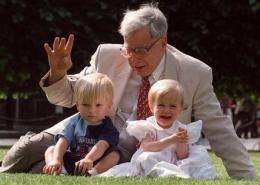
Professor Robert Edwards, the British pioneer of IVF treatment, sits with two of his 'test-tube-babies', Sophie and Jack Emery who celebrate their second birthday in London in this file photo dated Monday July 20, 1998. Test-tube baby pioneer Robert Edwards of Britain has won the 2010 Nobel Prize in medicine it is announced Monday Oct. 4, 2010. Edwards and some of his IVF test-tube children gatherd to celebrate the 20th anniversary of the birth of Louise Brown, the world's first "test tube" baby born in 1978. (AP Photo/Alastair Grant, File)

(AP) -- The Vatican's top bioethics official said Robert Edwards, who received the Nobel Prize in medicine Monday for developing in vitro fertilization, opened "a new and important chapter in the field of human reproduction" but is also responsible for the destruction of embryos and the creation of a "market" in donor eggs.

Monsignor Ignacio Carrasco de Paula, the newly appointed head of the Pontifical Academy for Life, said awarding the Nobel to Edwards is "not completely out of place." But he said it raised a great number of questions, not least because his research didn't treat the underlying problem of infertility but rather skirted it.

Edwards, an 85-year-old Briton who is professor emeritus at the University of Cambridge, won the prestigious award on Monday. The Nobel medicine prize committee said some 4 million people have been born through IVF.

The Vatican is opposed to IVF because it involves separating conception from the "conjugal act" - sexual intercourse between a husband and wife - and often results in the destruction of embryos. Church teaching holds that human life begins at conception, and must be given the consequent respect and dignity from that moment on.

In a statement e-mailed to The Associated Press, Carrasco nevertheless said Edwards "is not a figure to be underestimated."

"He has inaugurated a new and important chapter in the field of , whose best results are evident to all," he said citing Louise Brown - the first baby to be born through IVF, in 1978. Carrasco noted the woman, now 32, is herself the mother of a naturally conceived baby.

Still, he said, "without Edwards there wouldn't be a market of eggs."

"Without Edwards, there wouldn't be freezers full of waiting to be transferred in utero or, more likely, be used for research or to die, abandoned and forgotten by all," Carrasco said.

Carrasco stressed that he was offering a personal opinion, not a Vatican statement.

He was appointed in June to head the Vatican's pro-life academy, an advisory office composed of Catholic doctors, bioethicists, clergy and others who advise the pope on such hot-button and emotionally-charged issues as abortion, the right to die and assisted procreation.

In his statement to the AP, Carrasco blamed Edwards for the "current state of confusion of assisted procreation: children with four or five parents, babies born from their grandmothers."

"Edwards built a house but opened the wrong door," Carrasco said. IVF paved the way for "donations and sales involving human beings" and Edwards did not address the pathology of infertility.

Carrasco said the solution to the problem of infertility lies elsewhere and called for patience in research.

Explore further: Flesh-eating disease victim gets prosthetic hands

3.7 /5 (3 votes)
add to favorites email to friend print save as pdf

Related Stories

ICSI or IVF: Babies born from frozen embryos do just as well

Jun 29, 2009

Analysis of the longest running ICSI programme in the United States has found reassuring evidence that babies born from frozen embryos fertilised via ICSI (intracytoplasmic sperm injection) do just as well as those born from ...

Octuplets' birth raises bioethical questions

Feb 04, 2009

The birth of octuplets to a Southern California woman has raised several thorny ethical questions and trained a spotlight on the practice of reproductive medicine.

Test-tube kids and cancer? Method unlikely a cause

Jul 19, 2010

(AP) -- For the first time, a large study suggests a higher rate of childhood cancer among test-tube babies, but researchers say the reason probably has nothing to do with how the infants were conceived.

Recommended for you

Wireless ultrasound transducers help physicians

2 hours ago

Siemens has presented the world's first ultrasound system with wireless transducers. The system's transducers, which can be easily operated with one hand, transmit ultrasound images via radio waves to the ...

Cultural attitudes impede organ donations in China

May 17, 2013

(AP)—China is phasing out its reliance on executed prisoners for donated organs, but an architect of the country's transplant system said Friday that ingrained cultural attitudes are impeding the rise of ...

User comments : 8

Adjust slider to filter visible comments by rank

Display comments: newest first

frajo
4 / 5 (4) Oct 10, 2010
Church teaching holds that human life begins at conception, and must be given the consequent respect and dignity from that moment on.
The RCC is right to (re)claim respect and dignity for all human beings.
And the RCC will learn - perhaps in less than 500 years - that the biological construction of a human being needs a time span with a beginning (conception) and an ending (birth) as opposed to a single point in time.
otto1932
1 / 5 (1) Oct 10, 2010
The RCC is right to (re)claim respect and dignity for all human beings
Yes by making us all feel ashamed of ourselves as abject and unrepentant sinners.

Xian guilt- good for crowd control (bad doggie!)
"Without Edwards, there wouldn't be freezers full of embryos waiting to be transferred in utero or, more likely, be used for research or to die, abandoned and forgotten by all," Carrasco said.
As they cannot exist on their own, feed themselves, or reproduce, they cannot be considered life. And as they aren't alive, how can they die? Yes babies can feed themselves by wailing until they are presented with a teat. And they can suck, swallow, and digest. And excrete.
frajo
5 / 5 (3) Oct 11, 2010
The RCC is right to (re)claim respect and dignity for all human beings
Yes by making us all feel ashamed of ourselves as abject and unrepentant sinners.
Wrong generalization. Not us all; not you, not me; not the non-members of the RCC. That's a sin against clean/rational/unbiased thinking.
Skeptic_Heretic
2.3 / 5 (3) Oct 11, 2010
As they cannot exist on their own, feed themselves, or reproduce, they cannot be considered life. And as they aren't alive, how can they die? Yes babies can feed themselves by wailing until they are presented with a teat. And they can suck, swallow, and digest. And excrete.
Way overboard. A just born child has the ability to respirate wihtout assistance and with a constant source of energy (food) can maintain their own biological function. Once self sustainable, it is life, prior to that, it is chemistry.
otto1932
1 / 5 (1) Oct 11, 2010
The RCC is right to (re)claim respect and dignity for all human beings
My assertion is that the church purports to be the ultimate purveyor of goodness while in reality it was created for far different Reasons. It maintains the Show by taking the moral high ground by defending dignity and all that, while weakening the peoples will and self-respect by claiming they are helpless without surrender to a non-existent deity.

I do not trust the churches claims to Respect or dignity. They have an awful track record with respect to expending rights, freedoms, and morality in general. They derive their opinions about what constitutes life from a 2000 yo book- does that make sense? Otto says no.
Way overboard
Perhaps. But we both agree that a fetus is not alive until it can theoretically live outside the womb? I do think late-term or partial birth abortions shouldn't be allowed for this reason.
otto1932
1 / 5 (1) Oct 11, 2010
Wrong generalization. Not us all; not you, not me; not the non-members of the RCC. That's a sin against clean/rational/unbiased thinking.
As I've said before, the residue of Xian guilt pervades secular society. It may take generations to eliminate it from the culture. We caught it from our parents, we subconsciously pass it on to our children. We almost feel that self-conscious lack of self-confidence is a normal state. Is this because we still believe we are in need of forgiveness for being who we are and asking our own questions?
freethinking
1 / 5 (2) Oct 17, 2010
SH, Otto, a unborn baby is alive. I know your belief system cannot accept scientific principles. You laugh at creationists for being unscientific, but your belief that unborn babies are not alive or human is not based on science but rather your support of abortion.

Though I am not catholic I support the RCC in this. But I also support IVF IF all the unborn babies created are immediately implanted.

Otto as for guilt, all societies not just Christian cultures have guilt. I'm sure even athiests who kill have guilt. The only people without guilt for doing evil and bad things which include killing unborn babies are psychopaths.
freethinking
1 / 5 (1) Oct 17, 2010
Otto, Now to your Christian bashing.

Are you telling me that adulterous people have no guilt? What about prostitutes, are you telling me that they don't feel guilt? What about murderers? Like I said unless you are a psychopath, you must have guilt when you do evil.

Christianity cannot make a person feel guilty unless that person has done something evil that they are ashamed of in the first place. What Christianity has to offer is the ability to remove the guilt giving people hope and life.

http://www.youtub...7H1gXxrs

Christianity is about the truth and freedom. Taking people from where they are and providing them with freedom, hope and love.
http://www.youtub...DTrPn_UQ

More news stories

Breakthrough calls time on bootleg booze

(Phys.org) —Using a laser, the St Andrews scientists can now carry out detailed analysis of a spirit sample no bigger than a teardrop and can even confirm whether it is toxic or not. It's hoped the testing ...

Explainer: What are stem cells?

In a paper published in Cell yesterday, scientists from the US and Thailand have, for the first time, successfully produced embryonic stem cells from human skin cells. ...