NASA satellites see Tropical Storm Matthew grow quickly, warnings up in Central America
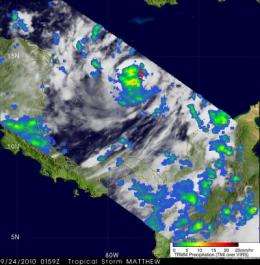
TRMM data from Sept. 24 at 0159 UTC showed moderate to heavy rainfall (red) southwest of Matthew's center of circulation. The approximate center of circulation is shown by a red tropical storm symbol. Credit: NASA/SSAI, Hal Pierce
An instrument on NASA's Aqua satellite noticed increasing colder cloud top temperatures of tropical depression 15 in the south-central Caribbean just before it strengthened into Tropical Storm Matthew late on Sept. 23. The TRMM satellite also spotted heavy rainfall within the system. Matthew is now headed to the western Caribbean and watches and warnings are in place as Matthew may continue to strengthen.
Cloud top temperatures indicate the strength of the storm to forecasters. The colder the cloud top temperatures, the stronger the convection and uplift. When cloud top temperatures drop, as they did in Atmospheric Infrared Sounder (AIRS) imagery captured on Sept. 23 at18:53 UTC (2:53 p.m. EDT) it indicates the storm is gaining strength. At that time, Matthew's maximum sustained winds were near 40 mph. In the image, the coldest cloud top temperatures (colder than -63 Fahrenheit) appeared around the center of Matthew's circulation already giving the appearance of an eye. The AIRS infrared image on Sept. 24 at 3:05 a.m. EDT showed a concentrated area of strong thunderstorms around Matthew's center as the sustained winds had increased to 50 mph.
AIRS has the ability to determine cloud top and sea surface temperatures from its position in space aboard NASA's Aqua satellite. Cloud top temperatures help forecasters know if a storm is powering up or powering down and Matthew is powering up.
In addition to the Aqua satellite, the Tropical Rainfall Measuring Mission (TRMM) satellite flew nearly above Matthews's location on Sep. 24 at 0159 UTC (9:59 p.m. EDT Sept. 23) capturing data used in a rainfall analysis done at NASA's Goddard Space Flight Center in Greenbelt, Md. TRMM Microwave Imager (TMI) data analyzed from this orbit showed moderate to heavy rainfall southwest of MATTHEW's center of circulation.
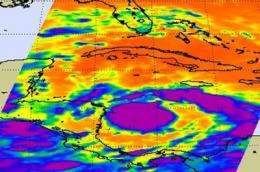
NASA's Aqua satellite's AIRS instrument generated infrared imagery of Matthew on Sept. 24 at 07:05 UTC (3:05 a.m. EDT). The coldest cloud top temperatures (colder than -63 Fahrenheit) appeared around the center of Matthew's circulation already giving the appearance of an eye. Credit: NASA JPL, Ed Olsen
At 11 a.m. EDT on Sept. 24, Matthew's maximum sustained winds were near 50 mph, and strengthening is expected in the warm Caribbean waters, so the National Hurricane Center said that Matthew could become a hurricane by Saturday. Meanwhile at 11 a.m. Sept. 24, Matthew was located about 80 miles east of Cabo Gracias a Dios, Nicaragua, near 14.4 North and 82.2 West. It was moving west at 20 mph, and had a minimum central pressure of 1001 millibars. Just 15 hours before, its minimum central pressure was 1005 millibars, and a drop in pressure indicates a strengthening storm.
A hurricane watch is in effect for Puerto Cabezas, Nicaragua to Limon, Honduras including the offshore islands. A tropical storm warning is in effect for Puerto Cabezas, Nicaragua to Limon, Honduras including the offshore islands.
A tropical storm warning is in effect for Puerto Cabezas, Nicaragua northward to the border with Honduras including the offshore islands and the coast of Honduras including the offshore islands. A tropical storm watch is in effect for the coast of Belize, while a hurricane watch is in effect for Puerto Cabezas, Nicaragua to Limon, Honduras. Hurricane conditions are possible between 11 p.m. EDT tonight and 11 a.m. EDT Saturday in that watch area.
Tropical storm-force winds are expected to reach the coastal warning areas during the afternoon of Sept. 24, and a storm surge is expected to produce flooding and dangerous surf. Expected rainfall amounts of 6 to 10 inches are forecast with isolated amounts to 15 inches.
According to the National Hurricane Center in Miami, on the forecast track the center of the Matthew is expected to be near the Nicaragua/Honduras border late Friday or early Saturday morning then move over land in northern Honduras on Saturday. Updates on Matthew can be found at the National Hurricane Center's web page: http://www.nhc.noaa.gov.
Provided by
NASA's Goddard Space Flight Center
-
From lemons to lemonade: Reaction uses carbon dioxide to make carbon-based semiconductor,
33 comments
-
Thioridazine kills cancer stem cells in human while avoiding toxic side-effects of conventional cancer treatments,
3 comments
-
SpaceX private rocket blasts off for space station (Update),
42 comments
-
Landmark calculation clears the way to answering how matter is formed,
55 comments
-
Research team claims to have found evidence Lake Cheko is impact crater for Tunguska Event,
18 comments
-
Hypothetical desert earth
May 26, 2012
-
More human population = greater mass?
May 25, 2012
-
Conversion from aircraft bearing to normal degrees
May 23, 2012
-
Interpretation/Analysis of the Lab results(HEPA filter)
May 22, 2012
-
Has anyone here attended the The Urbino Summer School in Paleoclimatology?
May 22, 2012
-
Earthquakes: Mag 6 N. Italy and Mag 5.6 W. Bulgaria
May 21, 2012
- More from Physics Forums - Earth
More news stories
Yale study concludes public apathy over climate change unrelated to science literacy
Are members of the public divided about climate change because they don't understand the science behind it? If Americans knew more basic science and were more proficient in technical reasoning, would public consensus match ...
12 hours ago |
4.8 / 5 (6) |
29
|
Land and sea species differ in climate change response: study
(Phys.org) -- Marine and terrestrial species will likely differ in their responses to climate warming, new research by Simon Fraser University and Australia’s University of Tasmania has found.
10 hours ago |
4 / 5 (5) |
6
|
10 million years needed to recover from mass extinction
It took some 10 million years for Earth to recover from the greatest mass extinction of all time, latest research has revealed.
Space & Earth / Earth Sciences
12 hours ago |
4.2 / 5 (5) |
3
|
Sophisticated simulations predict future warming
The chances of our planet being hit by a global warming of 3 degrees Celsius by 2050 is as likely as it being hit by an increase of 1.4 degrees, new research shows. Presented in the journal Nature Geoscience, the British study ...
Space & Earth / Earth Sciences
May 22, 2012 |
3.8 / 5 (11) |
51
Kyoto Protocol architect 'frustrated' by climate dialogue
UN climate talks are going nowhere, as politicians dither or bicker while the pace of warming dangerously speeds up, one of the architects of the Kyoto Protocol told AFP.
May 23, 2012 |
3.4 / 5 (8) |
43
Stunning image of smallest possible five-ringed structure
Scientists have created and imaged the smallest possible five-ringed structure about 100,000 times thinner than a human hair and you'll probably recognise its shape.
'Unzipped' carbon nanotubes could help energize fuel cells, batteries
Multi-walled carbon nanotubes riddled with defects and impurities on the outside could replace some of the expensive platinum catalysts used in fuel cells and metal-air batteries, according to scientists at ...
Change in developmental timing was crucial in the evolutionary shift from dinosaurs to birds: study
At first glance, it's hard to see how a common house sparrow and a Tyrannosaurus Rex might have anything in common. After all, one is a bird that weighs less than an ounce, and the other is a dinosaur that ...
Computer model used to pinpoint prime materials for efficient carbon capture
When power plants begin capturing their carbon emissions to reduce greenhouse gases and to most in the electric power industry, it's a question of when, not if it will be an expensive undertaking.
T cells 'hunt' parasites like animal predators seek prey, study shows
By pairing an intimate knowledge of immune-system function with a deep understanding of statistical physics, a cross-disciplinary team at the University of Pennsylvania has arrived at a surprising finding: T cells use a movement ...
Browser wars flare in mobile space
The browser wars are heating up again, but this time the fight is for dominance of the mobile Internet.
