GOES-13 sees tropical depression 15 form in the south-central Caribbean Sea
Sep 23, 2010
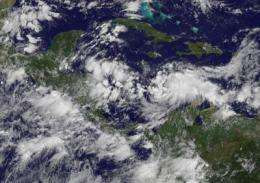
The GOES-13 satellite captured an image of Tropical Depression 15's rounded clouds at 1445 UTC (10:45 a.m. EDT) on Sept. 23 in the south-central Caribbean Sea. Credit: NOAA/NASA GOES Project

The fifteenth tropical depression of the Atlantic Ocean season has formed in the south-central Caribbean Sea, and the GOES-13 satellite captured its swirling mass of clouds and showers in a visible image today. Watches and warnings are already up for Central America.

At 2 p.m. EDT today, Sept. 23, Tropical Depression 15 had near 35 mph. It was located about 485 miles east of Puerto Cabezas, Nicaragua, near 13.9 North and 76.2 West. It was moving west at 15 mph, and had a minimum central pressure of 1007 millibars.

The government of Nicaragua has issued a tropical storm warning and a hurricane watch from Puerto Cabezas northward to the border with Honduras, including the offshore islands. The government of Honduras has issued a tropical storm warning and a hurricane watch from the Nicaragua/Honduras border westward to Limon including the offshore islands.

The latest from the GOES-13 satellite (the ) at 1445 UTC (10:45 a.m. EDT) on Sept. 23 shows Tropical Depression 15 as a rounded circulation in the south-central Caribbean. 15 is also over very warm waters, well over the 80 degree Fahrenheit threshold needed to power a tropical cyclone. That means that it will have the fuel to strengthen, and the National Hurricane Center forecasts that it would become a possibly within the next day.

GOES-13 is operated by the National Oceanic and Atmospheric Administration, and images are created by NASA's GOES Project, located at NASA's Goddard Space Flight Center, in Greenbelt, Md.

Nicaragua, Honduras, eastern Guatemala, Belize and Mexico's Yucatan Peninsula should all be making preparations for this storm.

Explore further: Professor argues Earth's mantle affects long-term sea-level rise estimates

add to favorites email to friend print save as pdf

Related Stories

Recommended for you

Russia evacuates drifting Arctic research station

11 hours ago

Russia has ordered the urgent evacuation of the 16-strong crew of a drifting Arctic research station after ice floe that hosts the floating laboratory began to disintegrate, officials said Thursday.

Bacterium from Canadian High Arctic and life on Mars

14 hours ago

(Phys.org) —The temperature in the permafrost on Ellesmere Island in the Canadian high Arctic is nearly as cold as that of the surface of Mars. So the recent discovery by a McGill University led team of ...

User comments : 0

More news stories

A hidden population of exotic neutron stars

(Phys.org) —Magnetars – the dense remains of dead stars that erupt sporadically with bursts of high-energy radiation - are some of the most extreme objects known in the Universe. A major campaign using ...

Hubble reveals the ring nebula's true shape

(Phys.org) —The Ring Nebula's distinctive shape makes it a popular illustration for astronomy books. But new observations by NASA's Hubble Space Telescope of the glowing gas shroud around an old, dying, ...

NASA head views progress on asteroid lasso mission

Surrounded by engineers, NASA chief Charles Bolden inspected a prototype spacecraft engine that could power an audacious mission to lasso an asteroid and tow it closer to Earth for astronauts to explore.

Controlling mood through the motions of mitochondria

(Medical Xpress)—Regulating the distribution of power in neurons is done by a system that makes the national electric grid look simple by comparison. Each neuron has several thousand mitochondria confined ...

A quantum simulator for magnetic materials

Physicists understand perfectly well why a fridge magnet sticks to certain metallic surfaces. But there are more exotic forms of magnetism whose properties remain unclear, despite decades of intense research. ...