Imaging study provides new view of multiple sclerosis
Sep 23, 2010
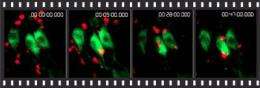
Researchers in Germany have gained new insight into how the immune system causes damage associated with multiple sclerosis, an incurable neuroinflammatory disorder. Using imaging tools which enable investigation of processes in living organisms, they were able to show a direct interaction between immune cells and neurons which plays a significant role in neuronal injury. However, this direct interaction may respond to therapeutic intervention. The study by Dr. Volker Siffrin and Professor Dr. Frauke Zipp has now been published in the journal Immunity. Credit: Dr. Volker Siffrin/Copyright: MDC

Scientists have uncovered an alternative source for some of the damage associated with multiple sclerosis (MS), an incurable neuroinflammatory disorder. The research, published online by Cell Press on September 23rd in the journal Immunity, reveals a direct interaction between immune cells and neurons that plays a significant role in neuronal injury and may respond to therapeutic intervention.

MS is an autoimmune disease in which a person's own immune system attacks their . Symptoms of MS are variable depending on which nerves are affected, but often include muscle weakness, numbness and visual disturbances. Research has shown that MS is caused by damage to the protective , an insulating substance that surrounds nerve processes and is critical for transmission of nerve impulses.

Research has also indicated that direct damage to neurons is prominent in early disease stages. "The contribution of direct neuronal damage to MS pathology has been debated since the first description of the disease," explains senior study author, Professor Frauke Zipp, from Johannes Gutenberg University Mainz in Germany. "Although many different theories about possible underlying mechanisms have been proposed, such as neuron damage being a secondary effect of the disrupted myelin sheath, actual events leading to neural damage are not well understood."

Dr. Zipp and colleagues studied the role of immune cells in neuronal damage in mice with experimental autoimmune encephalomyelitis (EAE, an of MS) by monitoring the development of neuroinflammatory lesions with sophisticated imaging techniques. They observed direct synapse-like interactions between immune cells and neurons. called Th17 cells, which have been linked to autoimmune inflammation, induced localized toxic changes in neuronal calcium levels. This is significant because fluctuations in neuronal intracellular calcium levels that were linked with cell injury were partially reversible when cells were exposed to compounds used to treat excitotoxicity.

These results highlight a specific interaction between the immune system and the nervous system, implicating direct neuronal damage in autoimmune-mediated inflammation. "Our use of live-imaging during disease has led to the characterization of neuronal dysfunction as early and potentially reversible, and suggests that immune-mediated disturbances of the neurons themselves contribute to multiple sclerosis, in addition to interruptions in nerve cell transmission as a result of changes to the myelin sheath," concludes Professor Zipp. "Furthermore, immune-mediated reversible calcium increases in neurons are a viable target for future therapeutics."

Explore further: Computational tool translates complex data into simplified 2-dimensional images

add to favorites email to friend print save as pdf

Related Stories

Cause of nerve fiber damage in multiple sclerosis identified

Oct 16, 2006

Researchers have identified how the body's own immune system contributes to the nerve fiber damage caused by multiple sclerosis, a finding that can potentially aid earlier diagnosis and improved treatment for this chronic ...

Gray matter under attack in multiple sclerosis

Apr 30, 2009

Autoimmune disease is a condition in which the immune system attacks the body's own material just as aggressively as it would attack a foreign pathogen. Multiple sclerosis, MS for short, is just one such autoimmune disease, ...

One size does not fit all: A new look at therapies

May 26, 2009

Statins, a commonly prescribed class of drugs used by millions worldwide to effectively lower blood cholesterol levels, may actually have a negative impact in Multiple Sclerosis (MS) patients treated with high daily dosages.

When helper cells aren't helpful

May 24, 2010

Current research suggests that T helper-type 1 (Th1) cells, previously thought to mediate autoimmunity, may actual inhibit the development of experimental immune encephalomyelitis (EAE), a mouse model of multiple sclerosis ...

Neurotransmitter defect may trigger autoimmune disease

Oct 06, 2008

A potentially blinding neurological disorder, often confused with multiple sclerosis (MS), has now become a little less mysterious. A new study by researchers at the Mayo Clinic in Rochester, Minnesota, may have uncovered ...

Recommended for you

Study suggests new source of kidneys for transplant

12 hours ago

Nearly 20 percent of kidneys that are recovered from deceased donors in the U.S. are refused for transplant due to factors ranging from scarring in small blood vessels of the kidney's filtering units to the organ going too ...

Do salamanders hold the solution to regeneration?

13 hours ago

Salamanders' immune systems are key to their remarkable ability to regrow limbs, and could also underpin their ability to regenerate spinal cords, brain tissue and even parts of their hearts, scientists have ...

Germ-fighting vaccine system makes great strides in delivery

16 hours ago

A novel vaccine study from South Dakota State University (SDSU) will headline the groundbreaking research that will be unveiled at the American Association of Pharmaceutical Scientists' (AAPS) National Biotechnology Conference ...

Discovery of novel medicine for treatment of chronic wounds

21 hours ago

Every 20 seconds, a limb is lost as a consequence of diabetic foot ulcer that does not heal. To date, medical solutions that can change this situation are very limited. In his doctoral thesis Yue Shen from the Industrial ...

User comments : 0

More news stories

Child maltreatment increases risk of adult obesity

Children who have suffered maltreatment are 36% more likely to be obese in adulthood compared to non-maltreated children, according to a new study by King's College London. The authors estimate that the prevention or effective ...

After a decade, global AIDS program looks ahead

(AP)—The decade-old law that transformed the battle against HIV and AIDS in developing countries is at a crossroads. The dream of future generations freed from the epidemic is running up against an era ...

New immune system discovered

(Medical Xpress)—A research team, led by Jeremy Barr, a biology post-doctoral fellow, unveils a new immune system that protects humans and animals from infection.

Do salamanders hold the solution to regeneration?

Salamanders' immune systems are key to their remarkable ability to regrow limbs, and could also underpin their ability to regenerate spinal cords, brain tissue and even parts of their hearts, scientists have ...

Lab sets a new record for creating heralded photons

(Phys.org) —Entanglement, by general consensus of physicists, is the weirdest part of quantum science. To say that two particles, A and B, are entangled means that they are actually two parts of an inseparable ...