Mars methane lasts less than a year
Sep 21, 2010
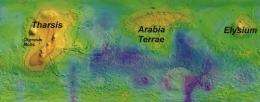
Map of methane concentrations in Autumn (first martian year observed) overlayed on true colour map of Mars. Credit: NASA/Universita del Salento

A new study indicates that methane in the atmosphere of Mars lasts less than a year. Methane is replenished from localized sources that show seasonal and annual variations. This pattern of methane production raises questions as to whether the methane comes from geological activity - or biological processes.

Methane in the atmosphere of lasts less than a year, according to a study by Italian scientists. Sergio Fonti (Universita del Salento) and Giuseppe Marzo (NASA Ames) have used observations from NASA’s Mars Global Surveyor spacecraft to track the evolution of the gas over three martian years. They presented their results at the European Congress in Rome on Tuesday 21st September.

“Only small amounts of are present in the , coming from very localized sources. We’ve looked at changes in concentrations of the gas and found that there are seasonal and also annual variations. The source of the methane could be geological activity or it could be biological -- we can’t tell at this point. However, it appears that the upper limit for methane lifetime is less than a year in the martian atmosphere,” said Fonti.

Levels of methane are highest in autumn in the northern hemisphere, with localized peaks of 70 parts per billion, although methane can be detected across most of the planet at this time of year. There is a sharp decrease in winter, with only a faint band between 40 and 50 degrees north. Concentrations start to build again in spring and rise more rapidly in summer, spreading across the planet.
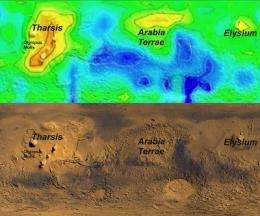
Top: Map of methane concentrations in Autumn (first martian year observed). Peak emissions fall over Tharsis (home to the Solar System’s largest volcano, Olympus Mons), the Arabia Terrae plains and the Elysium region, also the site of volcanos. Bottom: True color map of Mars. Credit: NASA/Universita del Salento

“One of the interesting things that we’ve found is that in summer, although the general distribution pattern is much the same as in autumn, there are actually higher levels of methane in the southern hemisphere. This could be because of the natural circulation occurring in the atmosphere, but has to be confirmed by appropriate ,” said Fonti.

There are three regions in the northern hemisphere where methane concentrations are systematically higher: Tharsis and Elysium, the two main volcano provinces, and Arabia Terrae, which has high levels of underground water ice. Levels are highest over Tharsis, where geological processes, including magmatism, hydrothermal and geothermal activity could be ongoing.

“It’s evident that the highest concentrations are associated with the warmest seasons and locations where there are favorable geological -- and hence biological -- conditions such as geothermal activity and strong hydration. The higher energy available in summer could trigger the release of gases from geological processes or outbreaks of biological activity,” said Fonti.

The mechanisms for removing methane from the atmosphere are also not clear. Photochemical processes would not break down the gas quickly enough to match observations. However, wind driven processes can add strong oxidizers to the atmosphere, such as the highly reactive salt perchlorate, which could soak up methane much more rapidly.

Martian years are nearly twice as long as Earth years. The team used observations from the Thermal Emission Spectrometer (TES) on Mars Global Surveyor between July 1999 and October 2004, which corresponds to three martian years the team studied one of the characteristic spectral features of methane in nearly 3 million TES observations, averaging data together to eliminate noise.
Mars methane lasts less than a year
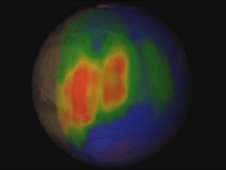
This image shows concentrations of Methane discovered on Mars. Credit: NASA

“Our study is the first time that data from an orbiting spectrometer has been used to monitor methane over an extended period. The huge TES dataset has allowed us to follow the methane cycle in the martian atmosphere with unprecedented accuracy and completeness. Our observations will be very useful in constraining the origins and significance of martian methane,” said Fonti.

Methane was first detected in the martian atmosphere by ground based telescopes in 2003 and confirmed a year later by ESA’s Mars Express spacecraft. Last year, observations using ground based telescopes showed the first evidence of a seasonal cycle.

The on Mars consists of 95% carbon dioxide, 3% nitrogen, 1.6% argon, and contains traces of oxygen and water, as well as methane.

Explore further: Cassini imaging lead hopes for planet-wide celebration of the Pale Blue Dot

Source: European Planetary Science Congress

4.9 /5 (16 votes)

Related Stories

A New Clue to the Hypothesis of Life on Mars

Sep 20, 2004

Recent analyses of ESA's Mars Express data reveal that concentrations of water vapour and methane in the atmosphere of Mars significantly overlap. This result, from data obtained by the Planetary Fourier Spectrometer ...

Mars Express mission extended

Sep 22, 2005

ESA’s Mars Express mission has been extended by one Martian year, or about 23 months, from the beginning of December 2005. The decision, taken on 19 September by ESA’s Science Programme Committee, allows ...

Life on Mars theory boosted by new methane study

Dec 08, 2009

Scientists have ruled out the possibility that methane is delivered to Mars by meteorites, raising fresh hopes that the gas might be generated by life on the red planet, in research published tomorrow in Earth an ...

Tooling up ExoMars

Jan 18, 2010

(PhysOrg.com) -- ESA and NASA are inviting scientists from across the world to propose instruments for their joint Mars mission, the ExoMars Trace Gas Orbiter. Scheduled for launch in 2016, the spacecraft ...

Just How Significant Is Methane On Titan?

Sep 12, 2005

Titan's second most abundant constituent, methane, is critical to the maintenance of an earth-like nitrogen atmosphere on this satellite. Without methane, Titan's nitrogen would condense, leaving behind a puny amount in ...

Mars, methane and mysteries

Aug 10, 2009

Mars may not be as dormant as scientists once thought. The 2004 discovery of methane means that either there is life on Mars, or that volcanic activity continues to generate heat below the martian surface. ...

Recommended for you

ExoMars 2016 set to complete construction

11 hours ago

ESA's mission to Mars in 2016 has entered the final stage of construction with the signature of a contract today with Thales Alenia Space at the Paris Air & Space Show.

Australian team maps Moon's hidden craters

14 hours ago

Australian scientists Tuesday said they had identified a possible 280 additional craters on the Moon, a finding they said could shed light on the history of the Earth's natural satellite.

User comments : 3

Adjust slider to filter visible comments by rank

Display comments: newest first

MrPressure
1 / 5 (1) Sep 23, 2010
The planet's location relative to the Sun and the galaxy's center, when hurricanes occur.

The Solar system moves further away from the center of the galaxy. Proportionally everything is expanding.

Occasionally the planet accelerates and slows down in relation to the Sun.

Currently, the Earth is accelerating pace. Galactic center releases massive neutrinos and smaller denser particles = energy particles.

These particles move through the planets. They get hit by energy which the nuclei of atoms that radiate towards each other. This energy makes these particles explode (motion) energy of atoms in its planetary cores.
MrPressure
1 / 5 (1) Sep 23, 2010
When the planet is further away from the galactic center than the Sun, particles moving from the center of the galaxy move past the Sun. During which they lose their energy to the Sun’s radiating energy field.

This is why they no longer have energy left for the planet’s core, causing the planets speed to slow down, until the sun passes on the planet.

These particles, still containing large quantities of energy, which they emanate to atom-cores within the planets core when passing by.
Electric charge of the atoms in planets core grows. The movement between atom-cores starts to accelerate, at this stage the particles coming from center of the galaxy get hit by increasing amounts of energy. They explode emanating their energy at planet’s core which accelerates movement of the planet.
MrPressure
1 / 5 (1) Sep 23, 2010
Currently the Earth accelerates further away from the galactic center. The particles from galactic center will interact strongly with the atomic nuclei in the earth’s core.

Earth releases a lot of energy.

American East Coast hurricanes are a sign here!

Also Mars get more and more energy from galaxy centre and thats why mars start moving faster far away from galaxy centre, what Sun. Then you see methan in Mars, you know.

Jupiter Redspot and Saturnus white spot is also sign. When Jupiter and Saturnus are get long time lot of energy for this particle who coming from galaxy centre.

More news stories