NASA eyes Typhoon Fanapi approaching Taiwan
Sep 17, 2010
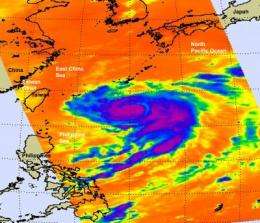
NASA's Aqua satellite passed over Typhoon Fanapi on Sept. 17 at 04:45 UTC (12:45 a.m. EDT) and captured this infrared image of its cold cloudtop temperatures. The coldest cloud tops were as cold as -60F, and the imagery showed a tight center circulation. Credit: NASA JPL, Ed Olsen

Infrared satellite data from NASA's Aqua satellite revealed strong convection and a tight circulation center within Typhoon Fanapi as it heads for a landfall in Taiwan this weekend.

At 1500 UTC (10 a.m. EDT) on Sept. 17, Fanapi's were near 85 knots (97 mph). It was centered about 360 nautical miles east-southeast of Taipei, Taiwan near 23.2 North and 127.4 East. It is churning up high seas up to 22 feet.

NASA's Aqua satellite passed over Typhoon Fanapi on September 17 at 04:45 UTC (12:45 a.m. EDT) and captured an infrared image of its cold cloudtop temperatures. The coldest cloud tops were as cold as -60F, and the imagery showed a tight center circulation at that time.

Infrared imagery today continues to show Fanapi consolidating. The typhoon is on the border of becoming a Category 2 typhoon on the Saffir-Simpson hurricane/typhoon scale. also showed that Fanapi has an 11 mile-wide eye, and that there's a small gap in the eyewall in the northern part of the circulation. Because vertical wind shear is expected to increase over the next 12 to 24 hours, Fanapi is expected to weaken at that time.

Another instrument on NASA's Aqua satellite captured a visible image of Typhoon Fanapi. To see the image that the (MODIS) instrument captured of Typhoon Fanapi on September 17 at 04:45 UTC, go to: http://rapidfire.sci.gsfc.nasa.gov/gallery/?2010260-0917/Fanapi.A2010260.0445.

Fanapi is now moving northwest at 6 mph and is expected to make landfall on Sept. 19 during the morning hours local Asia/Taipei time (late Sept. 18 EDT). Fanapi is forecast to cross Taiwan from east to west and then emerge into the Taiwan Strait as a tropical storm and make a final landfall in eastern China on Sept. 20.

Explore further: Satellites see storm system that created Moore, Okla., tornado

add to favorites email to friend print save as pdf

Related Stories

Recommended for you

NASA's BARREL mission launches 20 balloons

11 hours ago

(Phys.org) —In Antarctica in January, 2013 – the summer at the South Pole – scientists released 20 balloons, each eight stories tall, into the air to help answer an enduring space weather question: ...

Power of US tornado dwarfs Hiroshima bomb

12 hours ago

Wind, humidity and rainfall combined precisely to create Monday's massive killer tornado in Oklahoma. The awesome amount of energy released dwarfed the power of the atomic bomb that leveled Hiroshima.

Origins of human culture linked to rapid climate change

19 hours ago

Rapid climate change during the Middle Stone Age, between 80,000 and 40,000 years ago, during the Middle Stone Age, sparked surges in cultural innovation in early modern human populations, according to new research.

User comments : 0

More news stories

Power of US tornado dwarfs Hiroshima bomb

Wind, humidity and rainfall combined precisely to create Monday's massive killer tornado in Oklahoma. The awesome amount of energy released dwarfed the power of the atomic bomb that leveled Hiroshima.

Moore tornado a rarity, experts say

Tornados, among the most violent of atmospheric storms, rarely reach the size and brutality of the twister that swept through an Oklahoma City suburb on Monday, experts say.

First Look: New Xbox elegant, but much unknown

Will gamers want One? After four years of development, Microsoft unveiled the Xbox One entertainment console and touted it as an all-in-one solution for playing games, watching TV and doing everything in ...

Apple case seen as possible spur to tax action

Now that tech favorite Apple Inc. has been dragged front and center into the debate over the U.S. tax code, lawmakers are hoping that the spotlight on such a high-profile company could be the catalyst for ...

Study says empathy plays a key role in moral judgments

Is it permissible to harm one to save many? Those who tend to say "yes" when faced with this classic dilemma are likely to be deficient in a specific kind of empathy, according to a report published in the scientific journal ...