UN scientists say ozone layer depletion has stopped
Sep 16, 2010
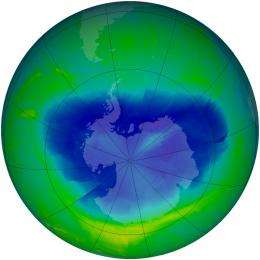
Antarctic Ozone Hole 2010. NASA image courtesy Ozone Hole Watch.

The protective ozone layer in the earth's upper atmosphere has stopped thinning and should largely be restored by mid century thanks to a ban on harmful chemicals, UN scientists said on Thursday.

The "Scientific Assessment of Ozone Depletion 2010" report said a 1987 international treaty that phased out chlorofluorocarbons (CFC) -- substances used in refrigerators, and some packing foams --- had been successful.

Ozone provides a natural protective filter against harmful ultra-violet rays from the sun, which can cause sunburn, cataracts and skin cancer as well as damage vegetation.

First observations of a seasonal ozone hole appearing over the Antarctic occurred in the 1970s and the alarm was raised in the 1980s after it was found to be worsening under the onslaught of CFCs, prompting 196 countries to join the Montreal Protocol.

"The Montreal Protocol signed in 1987 to control ozone depleting substances is working, it has protected us from further ozone deplation over the past decades," said World Meteorological Organisation head of research Len Barrie.

"Global ozone, including ozone in the is not longer decreasing but not yet incresing," he told journalists.

The 300 scientists who compiled the four yearly ozone assessment now expect that the in the stratosphere will be restored to 1980 levels in 2045 to 2060, according to the report, "slightly earlier" than expected.

Although CFCs have been phased out, they accumulated and persist in the atmosphere and the effect of the curbs takes years to filter through.

The ozone hole over the South Pole, which varies in size and is closely monitored when it appears in springtime each year, is likely to persist even longer and may even be aggravated by , the report said.

Scientists are still getting to grips with the complex interaction between and global warming, Barrie explained.

"In the Antarctic, the impact of the and the surface climate is becoming evident," he said.

"This leads to important changes in surface temperature and wind patterns, amongst other environmental changes," Barrie added.

CFCs are classified among greenhouse gases that cause global warming, so the phase out "provided substantial co-benefits by reducing climate change," the report found.

Barrie estimated that it had avoided about 10 gigatonnes of such emissions a year.

However, the ozone-friendly substances that have replaced CFCs in plastics or as refrigerants - hydrochlorofluorocarbons (HCFCs) and hydrofluorocarbons (HFCs) -- are also powerful greenhouse gases.

HFCs alone are regarded as 14,000 times more powerful than carbon dioxide (CO2), which is the focus of international efforts to tackle climate change, and HFC emissions are growing by eight percent a year, according to UN agencies.

"This represents a further potential area for action within the overall climate change challenge," said UN Environment Programme chief Achim Steiner in a statement.

Explore further: Alaska volcano shoots ash 15,000 feet into the air

add to favorites email to friend print save as pdf

Related Stories

Antarctic ozone - not a hole lot worse or better

Nov 10, 2005

The Antarctic ozone hole this year was the fourth largest to be recorded since measurements of ozone depletion began in 1979. CSIRO Marine and Atmospheric Research's expert in ozone depletion, Dr Paul Fraser, says while the ...

Study Finds Clock Ticking Slower On Ozone Hole Recovery

Jun 30, 2006

The Antarctic ozone hole's recovery is running late. According to a new NASA study, the full return of the protective ozone over the South Pole will take nearly 20 years longer than scientists previously expected.

NASA scientists reveal latest information on ozone hole

Sep 28, 2006

In 1987, the United States joined several other nations in signing the Montreal Protocol, an international treaty designed to protect the Earth's ozone layer by phasing out the production of a number of substances ...

Recommended for you

Alaska volcano shoots ash 15,000 feet into the air

May 18, 2013

(AP)—One of Alaska's most restless volcanoes has shot an ash cloud 15,000 feet into the air in an ongoing eruption that has drawn attention from a nearby community but isn't expected to threaten air traffic.

NASA sees Cyclone Mahasen hit Bangladesh

May 17, 2013

NASA's Tropical Rainfall Measuring Mission satellite known as TRMM measured Cyclone Mahasen's rainfall rates from space as it made landfall on May 16. Mahasen has since dissipated over eastern India.

Rapid climate change ruled out ice age trees

May 17, 2013

Short, sharp fluctuations in the Earth's climate throughout the last ice age may have stopped trees from getting a foothold in Europe and northern Asia, scientists say.

User comments : 6

Adjust slider to filter visible comments by rank

Display comments: newest first

vanderMerwe
3.2 / 5 (6) Sep 16, 2010
I suspect like most phenomena the ozone "hole" is a cyclical phenomena that looked like a growth trend because of the short observational time line. I wonder if we will see more envirocrazy demands that we repent and wear sackcloth and ashes the next time it decides to go down.

Next we'll be burning people in wicker men to get the spring to come. :-/
Skeptic_Heretic
1.5 / 5 (2) Sep 16, 2010
I suspect like most phenomena the ozone "hole" is a cyclical phenomena that looked like a growth trend because of the short observational time line. I wonder if we will see more envirocrazy demands that we repent and wear sackcloth and ashes the next time it decides to go down.

Next we'll be burning people in wicker men to get the spring to come. :-/

Well we know that ozone holes are expected, we expected them before we found them. The frightening part was how much larger they were than the hypotheses predicted. Those holes are now about where we expect them to be size wise considering the various influences that we're aware of. I'd say this particular announcement is citing a vicory for the Montreal protocol and CFC cap and trade.

The question is, is this announcement actual and sound or is it agatprop for a comming CO2 cap and trade plan. I would greatly prefer the former.
CarolinaScotsman
5 / 5 (2) Sep 16, 2010
"CFCs are classified among greenhouse gases that cause global warming, so the phase out "provided substantial co-benefits by reducing climate change,"

"However, the ozone-friendly substances that have replaced CFCs in plastics or as refrigerants - hydrochlorofluorocarbons (HCFCs) and hydrofluorocarbons (HFCs) -- are also powerful greenhouse gases. HFCs alone are regarded as 14,000 times more powerful than carbon dioxide (CO2)"

So if the replacements are just as bad as CFCs were for global warming, how did replacing one for the other help reduce climate change as was stated?
Sarai_RSA
not rated yet Sep 17, 2010
@Carolina: possibly a difference in the definition of ozone depletion and greenhouse gases.

Being that this has now been proved, can we please admit that we need a similar agreement re: carbon dio2? Policies policies and beauracratic hoo-ha.
projectpeace
not rated yet Sep 17, 2010
What the scientists don't mention is that the radiative effects of the boreal forests, that protect the Earth from solar radiation, is being reduced by logging. Atmospheric balance is being thrown off in another way by a change in atmospheric aerosol production of monoterpenes.

The best remedy for this is the cultivation of industrial hemp.
kennethetucker
not rated yet Sep 18, 2010
I suspect that most idiots that 'suspect' science are a coupla 'swatches' of homo sapiens DNA short of complete

More news stories

Heat-related deaths in Manhattan projected to rise

Residents of Manhattan will not just sweat harder from rising temperatures in the future, says a new study; many may die. Researchers say deaths linked to warming climate may rise some 20 percent by the 2020s, ...

Mice, gerbils perish in Russia space flight

A number of mice and eight gerbils sent into space in a Russian capsule destined to find out how well organisms can withstand extended flights perished during their journey, scientists said Sunday as the ...

Bold action, big money needed to curb Asia floods

Asia's flood-prone megacities should fund major drainage, water recycling and waste reduction projects to stem deluges and secure clean supply for their booming populations, experts said Sunday.

Kinks and curves at the nanoscale

One of the basic principles of nanotechnology is that when you make things extremely small—one nanometer is about five atoms wide, 100,000 times smaller than the diameter of a human hair—they are going ...

Honeybees trained in Croatia to find land mines

(AP)—Mirjana Filipovic is still haunted by the land mine blast that killed her boyfriend and blew off her left leg while on a fishing trip nearly a decade ago. It happened in a field that was supposedly ...