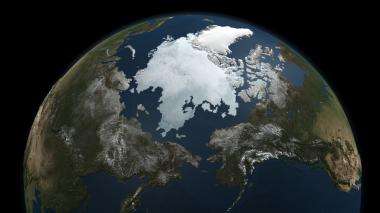
Arctic sea ice captured by satellite
Sep 14, 2010 by Kathryn Hansen
This image was compiled using data gathered by NASA's Aqua satellite on Sept. 3, 2010. Credit: NASA Goddard's Scientific Visualization Studio

The Arctic Ocean is covered by a dynamic layer of sea ice that grows each winter and shrinks each summer, reaching its yearly minimum size each fall. While the 2010 minimum remains to be seen, NASA's Aqua satellite captured this snapshot on Sept. 3.

How does the Aqua satellite "see" ? Microwaves. Everything on Earth’s surface -- including people -- emits microwave radiation, the properties of which vary with the emitter, thereby allowing the AMSR-E on Aqua to map the planet.

Ice emits more microwave radiation than water, making regions of the ocean with floating ice appear much brighter than the open ocean to the AMSR-E sensor. This difference allows the satellite to capture a sea ice record year-round, through cloud cover and the months of polar night. Continuous records are important because sea ice is dynamic. Besides melting and freezing, the ice moves with wind and currents which can cause it to split or pile up.

"The data from AMSR-E and other NASA satellites are critical for understanding the coupling between sea ice and the ocean and atmosphere," said Tom Wagner, Cryosphere program manager at NASA Headquarters in Washington. "It’s important for us to understand these connections to improve our predictive models of how the planet will change."

The is a major factor in the . The ice cools the planet by reflecting sunlight back into space. It also helps drive by converting the warm Pacific water that flows into the Arctic into the cold, saltier water that empties into the Atlantic. The sea ice also fundamentally shapes the Arctic; defining the organisms that make up its ecosystem and keeping heat from the from melting the frozen tundra.

In fall 2009, Arctic sea ice reached its minimum extent on about Sept. 12, and was the third lowest since satellite microwave measurements were first made in 1979. Researchers are interested in year-to-year changes, which can be highly variable, so that scientists need many years, even decades, of data to examine long-term trends. Notably, all of the major minimums have occurred in the last decade, consistent with other NASA research, which shows January 2000 to December 2009 was the warmest decade on record.

As the sea ice nears the 2010 minimum later this month, look for images and analysis from NASA and the National Snow and Ice Data Center, in Boulder, Colo.

Explore further: Alaska volcano shoots ash 15,000 feet into the air

add to favorites email to friend print save as pdf

Related Stories

Winter Sea Ice Fails to Recover, Down to Record Low

Apr 06, 2006

Scientists at NSIDC announced that March 2006 shows the lowest Arctic winter sea ice extent since the beginning of the satellite record in 1979 (see Figures 1 and 2). Sea ice extent, or the area of ocean that ...

'Remarkable' Drop in Arctic Sea Ice Raises Questions

Sep 26, 2007

Melting Arctic sea ice has shrunk to a 29-year low, significantly below the minimum set in 2005, according to preliminary figures from the National Snow and Ice Data Center, part of the University of Colorado ...

Recommended for you

Alaska volcano shoots ash 15,000 feet into the air

May 18, 2013

(AP)—One of Alaska's most restless volcanoes has shot an ash cloud 15,000 feet into the air in an ongoing eruption that has drawn attention from a nearby community but isn't expected to threaten air traffic.

NASA sees Cyclone Mahasen hit Bangladesh

May 17, 2013

NASA's Tropical Rainfall Measuring Mission satellite known as TRMM measured Cyclone Mahasen's rainfall rates from space as it made landfall on May 16. Mahasen has since dissipated over eastern India.

Rapid climate change ruled out ice age trees

May 17, 2013

Short, sharp fluctuations in the Earth's climate throughout the last ice age may have stopped trees from getting a foothold in Europe and northern Asia, scientists say.

Earth's iron core is surprisingly weak, researchers say

May 17, 2013

The massive ball of iron sitting at the center of Earth is not quite as "rock-solid" as has been thought, say two Stanford mineral physicists. By conducting experiments that simulate the immense pressures deep in the planet's ...

User comments : 2

Adjust slider to filter visible comments by rank

Display comments: newest first

patnclaire
2.5 / 5 (2) Sep 14, 2010
By golly! Henry Hudson and others were right all along. There is a Northwest Passage!
Waterworld here we come. {8-o
gunslingor1
5 / 5 (1) Sep 14, 2010
SWEAT! I love poisoned fish, black skies and toxic water. What a wonderful world... we have created for our selves.

Whoopi!

More news stories

Galaxy's Ring of Fire

Johnny Cash may have preferred this galaxy's burning ring of fire to the one he sang about falling into in his popular song. The "starburst ring" seen at center in red and yellow hues is not the product of ...

Alaska volcano shoots ash 15,000 feet into the air

(AP)—One of Alaska's most restless volcanoes has shot an ash cloud 15,000 feet into the air in an ongoing eruption that has drawn attention from a nearby community but isn't expected to threaten air traffic.

Chinese, Indian airlines face EU pollution fines

Eight Chinese and two Indian airlines face fines of up to several million euros for not paying for their greenhouse gas emissions during flights within the bloc, the European Commission said on Friday.

US seizes Bitcoin operator accounts

US authorities seized the accounts of a Bitcoin digital currency exchange operator, claiming it was functioning as an "unlicensed money service business," court documents showed Friday.

Morocco to harness the wind in energy hunt

Morocco is ploughing ahead with a programme to boost wind energy production, particularly in the southern Tarfaya region, where Africa's largest wind farm is set to open in 2014.