Tally-Ho! deep Impact spacecraft eyes comet target
Sep 08, 2010
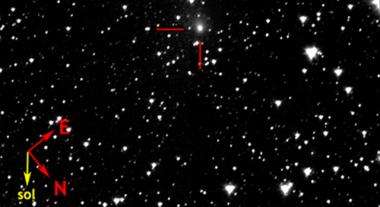
60 Days before its flyby, a NASA spacecraft takes a picture of its quarry - comet Hartley 2. Image credit: NASA/JPL/UM

(PhysOrg.com) -- NASA's Deep Impact spacecraft has beamed down the first of over 64,000 images it will be taking of Comet Hartley 2.

On Sunday, Sept. 5, NASA's spacecraft beamed down the first of more than 64,000 images it's expected to take of Hartley 2. The spacecraft, now on an extended mission known as EPOXI, has an appointment with the comet on Nov. 4, 2010.

It will use all three of the spacecraft's instruments (two telescopes with digital color cameras and an ) to scrutinize Hartley 2 for more than two months.

"Like any tourist who can't wait to get to a destination, we have already begun taking pictures of our comet -- Hartley 2," said Tim Larson, the project manager for EPOXI from NASA's Jet Propulsion Laboratory in Pasadena, Calif. "We have to wait for Nov. 4 to get the close-up pictures of the cometary nucleus, but these approach images should keep the science team busy for quite some time as well."

The imaging campaign, along with data from all the instruments aboard Deep Impact, will afford the mission's science team the best extended view of a comet in history during its pass through the . With the exception of one, six-day break to calibrate instruments and perform a trajectory correction maneuver, the spacecraft will continuously monitor Hartley 2's gas and dust output for the next 79 days.

This first image of comet Hartley 2 taken by Deep Impact was obtained by the spacecraft's Medium Resolution Imager on Sept. 5 when the spacecraft was 60 million kilometers (37.2 million miles) away from the comet.

EPOXI is an extended mission that utilizes the already "in flight" Deep Impact spacecraft to explore distinct celestial targets of opportunity. The name EPOXI itself is a combination of the names for the two extended mission components: the extrasolar planet observations, called Extrasolar Planet Observations and Characterization (EPOCh), and the flyby of comet Hartley 2, called the Deep Impact Extended Investigation (DIXI). The spacecraft will continue to be referred to as "Deep Impact."

Explore further: Building a better team—on Mars

add to favorites email to friend print save as pdf

Related Stories

Deep Impact correction maneuver successful

May 16, 2005

Fifty-nine days before going head-to-head with comet Tempel 1, NASA's Deep Impact spacecraft successfully executed the second trajectory correction maneuver of the mission. The burn further refined the spacecraft's trajectory, or ...

NASA Announces Another Comet Mission

Oct 31, 2006

NASA announced today that it has accepted the University of Maryland proposal to send the Deep Impact spacecraft on an extended mission to get a close-up look at Comet Boethin.

Recommended for you

Forecast for Titan: Wild weather could be ahead

55 minutes ago

(Phys.org) —Saturn's moon Titan might be in for some wild weather as it heads into its spring and summer, if two new models are correct. Scientists think that as the seasons change in Titan's northern hemisphere, ...

SDO observes mid-level solar flare

1 hour ago

UPDATE 16:30 p.m. EDT: The M7-class flare was also associated with a coronal mass ejection or CME, another solar phenomenon that can send billions of tons of particles into space. While this CME was not Ea ...

NASA's IRIS mission readies for a new challenge

10 hours ago

(Phys.org) —The time draws near. NASA is getting ready to launch a new mission, a mission to observe a largely unexplored region of the solar atmosphere that powers its dynamic million-degree outer atmosphere and drives ...

Building a better team—on Mars

May 21, 2013

Sometime in the next quarter-century, NASA plans to send the first humans to Mars, a mission that will push the boundaries of teamwork for a handful of astronauts who will spend as long as three years together ...

User comments : 0

More news stories

Forecast for Titan: Wild weather could be ahead

(Phys.org) —Saturn's moon Titan might be in for some wild weather as it heads into its spring and summer, if two new models are correct. Scientists think that as the seasons change in Titan's northern hemisphere, ...

SDO observes mid-level solar flare

UPDATE 16:30 p.m. EDT: The M7-class flare was also associated with a coronal mass ejection or CME, another solar phenomenon that can send billions of tons of particles into space. While this CME was not Ea ...

NASA's Landsat satellite looks for a cloud-free view

For decades, Landsat satellites have documented the desiccation of the Aral Sea in Central Asia. Once one of the largest seas in the world, it shrunk to a tenth of its original volume after Russia diverted ...

New cave-dwelling arachnids discovered in Brazil

Two new species of cave-dwelling short-tailed whipscorpions have been discovered in northeastern Brazil, and are described in research published May 22 in the open access journal PLOS ONE by Adalberto Santos ...