System for eliminating salt may point to new antihypertensives
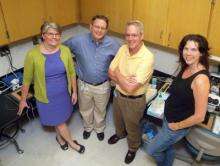
A study of the body system that deals with Americans' love affair with salt may yield more insight into why so many end up hypertensive and how to better treat them.
A team of scientists from the Medical College of Georgia, the University of Utah and the University of Texas at San Antonio is looking at how the kidneys know you've eaten too much salt and what they do to eliminate it. The work is funded by a $11.2 million National Institutes of Health Program Project grant.
Their focus, endothelin, ironically has a bad rep as a "death peptide" because of its shared ancestry with the Israeli burrowing asp that can shut down coronary arteries with one bite.
But the powerful protein produced by the kidney takes direction - good or bad - from its receptors, according to Dr. David Pollock, renal physiologist at MCG's Vascular Biology Center and director of the program project
"It's like politics: all things are local," said Pollock. In this case the upright guy tends to be the B receptor, which aids sodium excretion while its roguish sibling A receptor - the same one that shuts down the coronary arteries of asp victims - blocks it. When all goes well, the balancing act regulates the sodium level with the kidneys producing more endothelin and B receptors to eliminate the excess.
However in hypertension models, the B receptor doesn't work so well, although exactly why is still unclear. "It's this balance between A's and B's that is critical," Pollock said. "If your balance becomes unbalanced you will have salt-sensitive hypertension." That's why he is looking at the pathways that become activated on a high-salt diet and just what the A receptor is up to.
He and his colleagues are studying rats deficient in B receptors; they are a slightly hypertensive on a regular diet and very hypertensive on a high-salt diet. More circuitously, the researchers also infused angiotensin, a powerful blood vessel constrictor, into rats causing similar dysfunction of the B receptors.
"We also think without the B receptor function, your A's go a little bit crazy," Pollock said. Not only do the A's constrict, they promote inflammation, which can further damage blood vessels. In fact, a high-salt diet can cause even B receptors to behave badly, said Dr. Jennifer Pollock, MCG biochemist and a project leader.
Across the country, Dr. Donald Kohan, nephrologist and physiologist at the University of Utah, wants to figure out what prompts the kidneys to make more endothelin in the face of a high-salt diet. He is studying kidney cells to examine how endothelin production changes and ideally learn why. The goal, again, is drug therapies to inspire this natural phenomenon.
The results when A receptors go unchecked include stiff, tortuous blood vessels; a thick boggy pumping chamber in the heart; and other major organ damage that includes the kidney.
"The consequences are measurable targets," said Dr. Edward Inscho, MCG physiologist and a project leader, noting that treatments are available but "preventing it from occurring is something we are not very good at yet."
To help put the pieces together, Inscho is focusing on how blood vessels that feed directly into kidney filters react to a high-salt diet. Blood, containing salt, continuously flows through the kidneys. The researchers have seen that excess salt increases B receptor expression, which should help the kidneys filter more sodium then get rid of it.
"If you filter more, you have more salt available for excretion," Inscho said. He wants to know what's happening with A and B receptors inside the tiny vasculature of the kidneys. He's using B-deficient rats and drugs that block either receptor to get a better idea about both. The idea is to figure out not just how they normally work but how the system becomes dysfunctional in hypertension. "I think we are beginning to understand how the B receptor may factor into some other regulatory systems the kidney may use to control filtration," he said.
Noted Jennifer Pollock, "Your kidneys in theory should be able to lower your blood pressure but because people do remain hypertensive, that means there must a problem with your kidneys as well." She suspects that endothelin activates production of nitric oxide when it hits the B receptor. Nitric oxide, which dilates blood vessels, prompts the sodium channels in kidney tubules to fold inward.
"The salt can't get in and so it gets excreted," Jennifer Pollock said. "We are connecting the dots now." If they are correct, they have found a new mechanism for controlling salt excretion that is a natural drug target. Since it's difficult to enhance nitric oxide, it likely will be necessary to find another cue to prompt sodium channels to fold up their tents. She developed a mouse lacking nitric oxide synthase, which prompts nitric oxide production, to help pursue the theory.
Co-investigator Dr. James Stockand in Texas is investigating mechanisms for how endothelin affects transport of sodium in and out of the cell, focusing on proteins known as ion channels. Dr. Jennifer Sullivan, pharmacologist/physiologist at MCG's Vascular Biology Center, is providing support and expertise with the numerous animal models needed for the grant.
"The future of pharmaceutical therapies is going to be the right balance of different drugs," said David Pollock. "Most people with high blood pressure are also taking cholesterol medicine and possibly other drugs. So the future has to be what is the right formula for you and your situation."
The scientists hope their studies will point the way to these new, targeted options.


