Black rice rivals pricey blueberries as source of healthful antioxidants
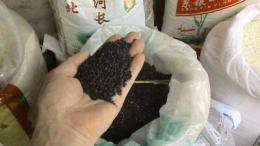
Health conscious consumers who hesitate at the price of fresh blueberries and blackberries, fruits renowned for high levels of healthful antioxidants, now have an economical alternative, scientists reported today at the 240th National Meeting of the American Chemical Society (ACS). It is black rice, one variety of which got the moniker "Forbidden Rice" in ancient China because nobles commandeered every grain for themselves and forbade the common people from eating it.
"Just a spoonful of black rice bran contains more health promoting anthocyanin antioxidants than are found in a spoonful of blueberries, but with less sugar and more fiber and vitamin E antioxidants," said Zhimin Xu, Associate Professor at the Department of Food Science at Louisiana State University Agricultural Center in Baton Rouge, La., who reported on the research. "If berries are used to boost health, why not black rice and black rice bran? Especially, black rice bran would be a unique and economical material to increase consumption of health promoting antioxidants."
Like fruits, "black rice" is rich in anthocyanin antioxidants, substances that show promise for fighting heart disease, cancer, and other diseases. Food manufacturers could potentially use black rice bran or the bran extracts to boost the health value of breakfast cereals, beverages, cakes, cookies, and other foods, Xu and colleagues suggested.
Brown rice is the most widely produced rice variety worldwide. Rice millers remove only the outer husks, or "chaff," from each rice grain to produce brown rice. If they process the rice further, removing the underlying nutrient rich "bran," it becomes white rice. Xu noted that many consumers have heard that brown rice is more nutritious than white rice. The reason is that the bran of brown rice contains higher levels of gamma-tocotrienol, one of the vitamin E compounds, and gamma-oryzanol antioxidants, which are lipid-soluble antioxidants. Numerous studies showed that these antioxidants can reduce blood levels of low-density lipoprotein cholesterol (LDL) — so called "bad" cholesterol — and may help fight heart disease. Xu and colleagues analyzed samples of black rice bran from rice grown in the southern United States. In addition, the lipid soluble antioxidants they found in black rice bran possess higher level of anthocyanins antioxidants, which are water-soluble antioxidants. Thus, black rice bran may be even healthier than brown rice bran, suggested Dr. Xu.
The scientists also showed that pigments in black rice bran extracts can produce a variety of different colors, ranging from pink to black, and may provide a healthier alternative to artificial food colorants that manufacturers now add to some foods and beverages. Several studies have linked some artificial colorants to cancer, behavioral problems in children, and other health problems.
Black rice is used mainly in Asia for food decoration, noodles, sushi, and pudding. Dr. Xu said that farmers are interested in growing black rice in Louisiana and that he would like to see people in the country embrace its use.
Provided by American Chemical Society


