Researchers 'stretch' a lackluster material into a possible electronics revolution
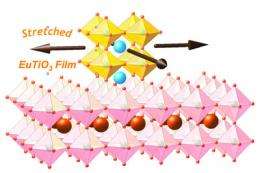
It's the Clark Kent of oxide compounds, and - on its own - it is pretty boring. But slice europium titanate nanometers thin and physically stretch it, and then it takes on super hero-like properties that could revolutionize electronics, according to new Cornell research. (Nature, Aug. 19, 2010.)
Researchers report that thin films of europium titanate become both ferroelectric (electrically polarized) and ferromagnetic (exhibiting a permanent magnetic field) when stretched across a substrate of dysprosium scandate, another type of oxide. The best simultaneously ferroelectric, ferromagnetic material to date pales in comparison by a factor of 1,000.
Simultaneous ferroelectricity and ferromagnetism is rare in nature and coveted by electronics visionaries. A material with this magical combination could form the basis for low-power, highly sensitive magnetic memory, magnetic sensors or highly tunable microwave devices.
The search for ferromagnetic ferroelectrics dates back to 1966, when the first such compound - a nickel boracite - was discovered. Since then, scientists have found a few additional ferromagnetic ferroelectrics, but none stronger than the nickel compound - that is, until now.
"Previous researchers were searching directly for a ferromagnetic ferroelectric - an extremely rare form of matter," said Darrell Schlom, Cornell professor of materials science and engineering, and an author on the paper.
"Our strategy is to use first-principles theory to look among materials that are neither ferromagnetic nor ferroelectric, of which there are many, and to identify candidates that, when squeezed or stretched, will take on these properties," said Craig Fennie, assistant professor of applied and engineering physics, and another author on the paper.
This fresh strategy, demonstrated using the europium titanate, opens the door to other ferromagnetic ferroelectrics that may work at even higher temperatures using the same materials-by-design strategy, the researchers said.
Other authors include David A. Muller, Cornell professor of applied and engineering physics; and first author June Hyuk Lee, a graduate student in Schlom's lab.
The researchers took an ultra-thin layer of the oxide and "stretched" it by placing it on top of the disprosium compound. The crystal structure of the europium titanate became strained because of its tendency to align itself with the underlying arrangement of atoms in the substrate.
Fennie's previous theoretical work had indicated that a different kind of material strain - more akin to squishing by compression - would also produce ferromagnetism and ferroelectricity. But the team discovered that the stretched europium compound displayed electrical properties 1,000 times better than the best-known ferroelectric/ferromagnetic material thus far, translating to thicker, higher-quality films.
This new approach to ferromagnetic ferroelectrics could prove a key step toward the development of next-generation memory storage, superb magnetic field sensors and many other applications long dreamed about. But commercial devices are a long way off; no devices have yet been made using this material. The Cornell experiment was conducted at an extremely cold temperature - about 4 degrees Kelvin (-452 Fahrenheit). The team is already working on materials that are predicted to show such properties at much higher temperatures.
Provided by Cornell University


