Greenhouse gas calculator connects farming practices with carbon credits
Greenhouse gas markets, where invisible gases are traded, must seem like black boxes to most people. Farmers can make money on these markets, such as the Chicago Climate Exchange, by installing methane capture technologies in animal-based systems, no-till farming, establishing grasslands, and planting trees.
Farmers, students, extension educators, offset aggregators, and other stakeholders need to understand how to change farming practices to maximize their potential economic returns in these new markets.
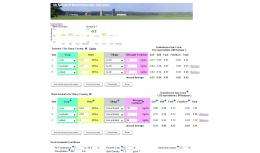
To open the black box, researchers at the W.K. Kellogg Biological Station, including Claire P. McSwiney, Sven Bohm, Peter R. Grace, and G. Philip Robertson, developed the Farming Systems Greenhouse Gas Emissions Calculator, a simple web-based tool to help users make economically and environmentally sound decisions.
The first page of the calculator asks users to choose a county of interest from anywhere in the US. An input/output window allows them to choose which crops they will grow, yields, tillage practices, and nitrogen fertilizer rates. Default values based on localized USDA statistics are provided as a starting point.
Given the farming practices chosen, the calculator tells the user how much carbon was stored in the soil or lost to the atmosphere, nitrous oxide (a greenhouse gas 300 times more potent than carbon dioxide) lost from the soil in response to fertilizer application, carbon dioxide produced by tractors, and carbon dioxide produced in manufacturing the fertilizer.
In an article in the 2010 Journal of Natural Resources and Life Science Education, published by the American Society of Agronomy, the Crop Science Society of America, and the Soil Science Society of America, the authors used the calculator to demonstrate how tillage compares with no-till in a three-year rotation of corn, soybean, and wheat.
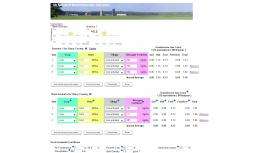
Whether tilled or untilled, corn years always had the largest greenhouse gas losses due to large fertilizer additions. Wheat requires less fertilizer and soybeans require none. No-till management reduced greenhouse gas emissions by 50% due to soil carbon storage.
In another comparison, the amount of fertilizer applied was changed from 134 to 101 kg. Such a reduction could be achieved without a yield penalty by more precisely applying fertilizers or by using new fertilizer recommendations. Excess nitrogen in soil is readily transformed to nitrous oxide. By simply reducing fertilizer applications, the cropping system reduced greenhouse gas emissions 12%.
In an Environmental Science class at Kalamazoo College, the authors used the calculator for an in-class exercise. Using the farming systems calculator allowed students to take control and make the management changes they had been discussing for weeks. By making the management decisions themselves and 'seeing' what happened to soil carbon, the connections between changes in farm practices and the potential for economic gain became much clearer.
Farmers and other agricultural professionals can use the program to participate in similar exercises. By comparing different cropping scenarios against one another, the practices with the most promise for mitigating atmospheric greenhouse gas concentrations become readily apparent. Those not familiar with agriculture learn how certain farming practices can have a positive environmental impact.
More information: The greenhouse gas calculator is available at www.kbs.msu.edu/ghgcalculator/
Provided by American Society of Agronomy


