August 4, 2010 feature
Autonomous quantum error correction technique proposed for quantum memories
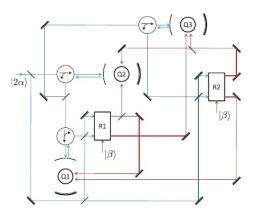
(PhysOrg.com) -- While words such as "powerful" and "efficient" are often used to describe the potential of quantum computing, these quantum systems can be very fragile at the same time. Errors in quantum systems can easily arise due to decoherence - which occurs when a quantum state interacts with its environment - as well as unwanted noise or defective components. In order to protect quantum systems from these problems, physicists use quantum error correction (QEC) techniques to identify and correct errors without disturbing the system.
In a recent study, physicists have developed a new QEC technique that can be directly embedded into quantum memories. Because the method is implemented "on-chip," it requires no external clocking or logic. In addition, all control operations are performed autonomously by an embedded feedback loop, which is different than most previous QEC approaches. The researchers hope that the design could be useful for nanophotonics implementations and quantum-optical engineering.
“Good QEC designs can improve implementation efficiency by reducing the hardware and computational ‘overhead’ that is needed in the implementation of the QEC for a particular quantum memory scheme,” coauthor Hendra Nurdin of Stanford University and the Australian National University told PhysOrg.com.
In general, it’s much more difficult to design QEC methods than it is to design classical error correction methods because in classical methods, bits can simply be copied for redundancy. However, qubits cannot be copied in the same way due to the non-cloning theorem. Yet physicists can get around this limitation in a few ways, such as by encoding a single “logical” qubit (representing the information carried) in the entangled state of three “physical” qubits using a technique called the bit-flip code.
The new autonomous QEC technique is based on the bit-flip code and another similar strategy called the phase-flip code, and can protect the stored information against independent unwanted flips to any, but not more than one, of the physical qubits. Whereas previous QEC approaches usually involved discrete restoration steps, the new approach involves a continuous syndrome readout to diagnose and correct errors. In this approach, each physical qubit is strongly coupled to its own optical cavity. If an error occurs so that one of the physical qubits has its state flipped, two feedback signals are sent to the qubit to flip it back and correct the error. The system is autonomous in that probe signals are continuously providing feedback to the qubits: less than two feedback signals in the case of no errors, and two feedback signals in the case of an error.
“This QEC design has the potential to be embedded on the same hardware platform as the quantum memory, such as in nanophotonics, and has the potential for reduced hardware overhead requirements because it does not require external clocking and logic to operate, nor does not it require interfacing to measurement devices,” Nurdin said. “Moreover, since all processing is performed coherently, no classical computations are required to determine the corrective feedback signals.”
Although the current design is just a proposal, the physicists explain that the circuitry could be realized with available technology, such as solid-state qubits coupled to electromagnetic resonators and waveguides. In the future, the scientists also plan to find ways to extend the design to QEC feedback networks that can correct a wider variety of qubit errors.
More information: Joseph Kerckhoff, et al. “Designing Quantum Memories with Embedded Control: Photonic Circuits for Autonomous Quantum Error Correction.” Physical Review Letters 105, 040502 (2010).
Copyright 2010 PhysOrg.com.
All rights reserved. This material may not be published, broadcast, rewritten or redistributed in whole or part without the express written permission of PhysOrg.com.


