Galapagos dropped from UNESCO endangered list
Jul 29, 2010
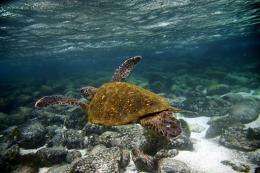
A Green sea turtle (Chelonia mydas) swims underwater in San Cristobal island, Galapagos Archipelago, in 2009. UNESCO's World Heritage Committee said Wednesday it has removed Ecuador's Galapagos Islands from its list of endangered sites, due to Quito's protective efforts in the Pacific archipelago.

UNESCO's World Heritage Committee said Wednesday it has removed Ecuador's Galapagos Islands from its list of endangered sites, due to Quito's protective efforts in the Pacific archipelago.

"By a vote of 14 to five, with one abstention," the committee removed the islands from its endangered environments list, where it was included in 2007, said Brazil's Culture Ministry, which presides over this week's committee meeting in Brasilia.

"It's important to recognize the Ecuadoran government's effort in protecting and preserving this heritage site," Brazilian Heritage Institute president Luiz Fernando de Almeida said in a statement.

Brazil had requested that the Galapagos be removed from the .

Located 1,000 kilometers (620 miles) west of Ecuador's coast, the Galapagos archipelago of 13 main islands and 17 islets has been a since 1978 for its rich plant and animal life both on land and in the surrounding sea.

In 2007, the organization declared the island chain's environment endangered due to the increase of tourism and the introduction of invasive species.

Some 10,000 people, mostly fishermen, live on the volcanic archipelago, which rose from the Pacific seabed 10 million years ago and became famous when Darwin visited to conduct research in 1835.

The United Nations Educational, Scientific and Cultural Organization's List of World Heritage in Danger includes 31 cultural or natural sites around the globe at imminent risk of degradation or destruction.

The 34th annual meeting of the World Heritage Committee this year takes place in the Brazilian capital from July 25 to August 3.

Explore further: Hydro power frenzy 'threatens Carpathian mountains'

add to favorites email to friend print save as pdf

Related Stories

Volcanic eruption takes toll on Galapagos wildlife

Apr 16, 2009

A volcanic eruption over the weekend has taken a toll on the wildlife of the ecologically-fragile Galapagos Islands, causing the deaths of numerous fish and various sea lions, said officials on Thursday.

A new baseline of invasive plants in Isabela

Oct 17, 2007

Charles Darwin Foundation (CDF) botanists have published a list of all the introduced plants growing in Puerto Villamil, Isabela Island, the third largest town in Galapagos. 261 species were recorded, 39 of which were found ...

Save our reef, save our heritage

Jul 19, 2007

Protecting the Great Barrier Reef from the impacts of climate change, natural disasters and rising human pressures will be a key test of Australia’s ability to keep our natural environment healthy and resilient.

Recommended for you

Unkempt, weedy land unintentionally boosts wildlife

18 hours ago

Parts of the farm landscape that look overgrown and 'scruffy' are more important in supporting wildlife than they first appear, according to new research published today in Ecology Letters.

Why we need to put the fish back into fisheries

May 20, 2013

Overfishing has reduced fish populations and biodiversity across much of the world's oceans. In response, fisheries are increasingly reliant on a handful of highly valuable shellfish. However, new research by the University ...

User comments : 0

More news stories

Child maltreatment increases risk of adult obesity

Children who have suffered maltreatment are 36% more likely to be obese in adulthood compared to non-maltreated children, according to a new study by King's College London. The authors estimate that the prevention or effective ...

New immune system discovered

(Medical Xpress)—A research team, led by Jeremy Barr, a biology post-doctoral fellow, unveils a new immune system that protects humans and animals from infection.

Lab sets a new record for creating heralded photons

(Phys.org) —Entanglement, by general consensus of physicists, is the weirdest part of quantum science. To say that two particles, A and B, are entangled means that they are actually two parts of an inseparable ...