GRAIL Spacecraft Takes Shape
Jul 29, 2010
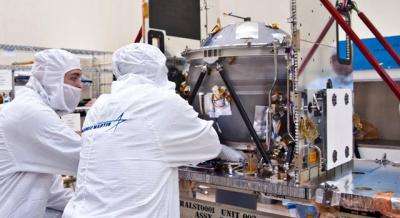
Engineers conduct checks on one of NASA's GRAIL spacecraft in the Space Support Building at Lockheed Martin Space Systems in Denver.

(PhysOrg.com) -- Engineers have conducted a fuel tank check of one of NASA's GRAIL mission spacecraft, scheduled for launch in 2011.

Confirming the size and fit of manufactured components is one of the steps required prior to welding the spacecraft's fuel tanks into the propulsion system's feed lines.

The image was taken on June 29, 2010, during the propulsion subsystem assembly and integration effort in the Space Support Building clean room at Space Systems in Denver.

The GRAIL mission will fly twin spacecraft (spacecraft "A" and "B") in tandem orbits around the moon for several months to measure its in unprecedented detail. The mission will also answer longstanding questions about Earth's moon, and provide scientists a better understanding of how Earth and other in the solar system formed.

Explore further: Communications satellite launched into space

More information: For more information about GRAIL, please visit: moon.mit.edu

add to favorites email to friend print save as pdf

Related Stories

Juno Taking Shape in Denver

Apr 06, 2010

(PhysOrg.com) -- Assembly has begun on NASA's Juno spacecraft, which will help scientists understand the origin and evolution of Jupiter. The mission, whose principal investigator is Scott Bolton of Southwest ...

Dawn Glides Into New Year

Nov 21, 2008

(PhysOrg.com) -- NASA's Dawn spacecraft shut down its ion propulsion system today as scheduled. The spacecraft is now gliding toward a Mars flyby in February of next year.

Dawn Mission Status: Spacecraft Tests Ion Engine

Oct 10, 2007

NASA's Dawn spacecraft successfully completed the first test of its ion propulsion system over the weekend. The system is vital to the success of Dawn's 8-year, 1.6 billion-mile (3-billion-kilometer) journey ...

Recommended for you

Dark, massive asteroid to fly by Earth on May 31

May 24, 2013

It's 1.7 miles long. Its surface is covered in a sticky black substance similar to the gunk at the bottom of a barbecue. If it impacted Earth it would probably result in global extinction. Good thing it is ...

Research team explains 'Lazarus' comets

May 24, 2013

Astronomers from the University of Antioquia have discovered a graveyard of comets. These once-dormant comets, dubbed by astronomers as "The Lazarus comets," are now rejuvenated.

NASA ships sensors for seafaring satellite to France

May 24, 2013

(Phys.org) —Three NASA-built instruments that are integral components of the next in a series of U.S./European ocean altimetry satellites have arrived in France for integration with their spacecraft in ...

Trip into space with DiCaprio costs $1.55m

May 24, 2013

Leonardo DiCaprio is going to get closer to stars of a different kind as he heads into space aboard the Virgin Galactic, and a well-heeled bidder at the Cannes Film Festival has paid 1.2 million euros (1.5 million) to be ...

User comments : 0

More news stories

Galaxies fed by funnels of fuel

(Phys.org) —Computer simulations of galaxies growing over billions of years have revealed a likely scenario for how they feed: a cosmic version of swirly straws.

Century-old science helps confirm global warming

(Phys.org) —Ocean measurements taken more than 135 years ago during the scientific expedition of HMS Challenger have provided further confirmation of human-produced global warming over the past century.