Specific protein may help neurons fix themselves in Parkinson's patients
Jul 22, 2010
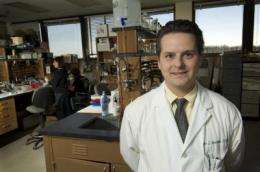
John Goudreau, director of Michigan State University's Translational Neurobiology Research Unit, believes parkin can rescue certain neurons from injury induced by Parkinson’s disease. Credit: Kurt Stepnitz

A Michigan State University researcher is working to uncover how a protein known as parkin may help nerve cells fight off damage from Parkinson's disease, a strategy that could lead to new therapies for the degenerative ailment.

John Goudreau, an osteopathic physician and director of MSU's Translational Neurobiology Research Unit, believes parkin can rescue certain from injury induced by Parkinson's disease.

He has been awarded $1.5 million from the National Institutes of Health's National Institute of Neurological Disorders and Stroke to test his hypothesis.

"Parkinson's is a progressive disease, and much of the research has been focused on slowing that progression by preventing cell injury and death," said Goudreau, who holds appointments in MSU's departments of Neurology and Pharmacology/Toxicology in the College of Osteopathic Medicine. "But we are looking at why some neurons in the are able to fight off the disease through a unique ability to revive after being hit with an injury that kills other cells."

There is a "selective vulnerability" with Parkinson's disease, he said, where in the mid-brain are damaged while cells in the hypothalamic region of the brain are spared since they have the capacity to quickly bounce back after being damaged.

Goudreau's research team has discovered that the protein parkin is essential for these hypothalamic neurons to recover.

"What we now want to find out is how parkin facilitates this recovery," said Goudreau, who has been studying Parkinson's disease for nearly a decade at MSU and has received more than $2 million in external funding for clinical and translational research.

Using human cell cultures and mice, the research team will attempt to isolate exactly what the parkin protein is doing and how it helps neurons return to health after being damaged. Two theories: Parkin may allow cells to rebound from injury by aiding in energy production within the cell, or it may improve a cell's ability to dispose of other proteins damaged by Parkinson's disease.

Either way, Goudreau said, understanding the steps underlying parkin's ability to promote neuron recovery will identify targets for therapies to slow the progression of Parkinson's disease.

"From a clinical standpoint, once a Parkinson's patient presents symptoms and seeks treatment, many neurons in the brain have already been injured and many cells are already dead," he said. "But there is a population of injured neurons that still have the potential to recover.

"Understanding how parkin promotes recovery from injury may allow us to provide cells injured by Parkinson's disease the necessary tools to survive."

Explore further: Study suggests new source of kidneys for transplant

add to favorites email to friend print save as pdf

Related Stories

Recommended for you

Study suggests new source of kidneys for transplant

5 hours ago

Nearly 20 percent of kidneys that are recovered from deceased donors in the U.S. are refused for transplant due to factors ranging from scarring in small blood vessels of the kidney's filtering units to the organ going too ...

Do salamanders hold the solution to regeneration?

6 hours ago

Salamanders' immune systems are key to their remarkable ability to regrow limbs, and could also underpin their ability to regenerate spinal cords, brain tissue and even parts of their hearts, scientists have ...

Germ-fighting vaccine system makes great strides in delivery

9 hours ago

A novel vaccine study from South Dakota State University (SDSU) will headline the groundbreaking research that will be unveiled at the American Association of Pharmaceutical Scientists' (AAPS) National Biotechnology Conference ...

Discovery of novel medicine for treatment of chronic wounds

14 hours ago

Every 20 seconds, a limb is lost as a consequence of diabetic foot ulcer that does not heal. To date, medical solutions that can change this situation are very limited. In his doctoral thesis Yue Shen from the Industrial ...

User comments : 0

More news stories

Do salamanders hold the solution to regeneration?

Salamanders' immune systems are key to their remarkable ability to regrow limbs, and could also underpin their ability to regenerate spinal cords, brain tissue and even parts of their hearts, scientists have ...

Practice makes perfect? Not so much

Turns out, that old "practice makes perfect" adage may be overblown. New research led by Michigan State University's Zach Hambrick finds that a copious amount of practice is not enough to explain why people ...

New immune system discovered

(Medical Xpress)—A research team, led by Jeremy Barr, a biology post-doctoral fellow, unveils a new immune system that protects humans and animals from infection.

Study shows how bilinguals switch between languages

(Medical Xpress)—Individuals who learn two languages at an early age seem to switch back and forth between separate "sound systems" for each language, according to new research conducted at the University of Arizona.

Lab sets a new record for creating heralded photons

(Phys.org) —Entanglement, by general consensus of physicists, is the weirdest part of quantum science. To say that two particles, A and B, are entangled means that they are actually two parts of an inseparable ...

Protein study suggests drug side effects are inevitable

A new study of both computer-created and natural proteins suggests that the number of unique pockets – sites where small molecule pharmaceutical compounds can bind to proteins – is surprisingly small, meaning drug side ...