'The friend of my enemy is my enemy': Virtual universe study proves 80-year-old theory on how humans interact
A new study analysing interactions between players in a virtual universe game has for the first time provided large-scale evidence to prove an 80 year old psychological theory called Structural Balance Theory. The research, published today in PNAS, shows that individuals tend to avoid stress-causing relationships when they develop a society, resulting in more stable social networks.
Today's study, carried out at Imperial College London, the Medical University of Vienna and the Santa Fe Institute, analyses relationships between 300,000 players in an online game called Pardus. In this open-ended game, players act as spacecraft exploring a virtual universe, where they can make friends and enemies, and communicate, trade and fight with one another.
Scientists currently study data from people's electronic interactions, such as emails, mobile phones and online retail behaviour, to improve our understanding of human societies. Online games such as Pardus produce vast amounts of data that scientists can also use to study interactions between players, applying their findings to understanding the way that people interact in society.
Structural Balance Theory is an 80 year old psychological theory that suggests some networks of relationships are more stable than others in a society. Specifically, the theory deals with positive and negative links between three individuals, where 'the friend of my enemy is my enemy' is more stable (and therefore more common) than 'the friend of my friend is my enemy'.
In today's study, information about interactions between players in the game is more detailed than that from other electronic sources, because it includes data on the types of relationship and whether the interactions are positive or negative. This has enabled the authors of the study to show that positive relationships form stable networks in society, proving Structural Balance Theory for the first time.
Dr Renaud Lambiotte, one of the authors of the study from the Institute for Mathematical Sciences at Imperial College London, said: "I find it fascinating to understand how we all interact with one another to form complex social networks. I think it is astounding that I'm this tiny point in such an enormous network of people. Our new study reveals in more detail than ever before the key ingredients that make these networks stable."
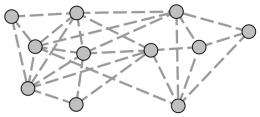
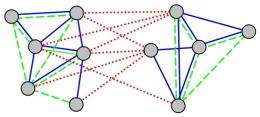
In today's study, mathematicians looked at six types of interaction between players in an online game: friendship, communication, trade, hostility, aggression and punishment. Each one defines a network on its own; all six together combine to form one large network. A unique aspect of the data is that some of the links have a positive connotation (friendship, communication and trade), while others correspond to negative interactions (hostility, aggression and punishment).
The researchers analysed data from the game on two levels: first by analysing individual networks; and then by looking at the interplay between all the networks.
The authors found that in positive relationships, players are more likely to reciprocate actions and sentiments than in negative ones. For example, if player A declares player B to be their friend, player B is likely to do the same. If player A declares player B to be their enemy, however, player B is not likely to reciprocate.
The research also revealed strong interactions between different types of links, with some networks overlapping extensively, as players are likely to engage in similar interactions, and others tending to exclude each other. For example, friendship and communication networks overlap: as we would expect, friends tend to talk to each other. However, trade and hostility did not overlap at all, showing that enemies tend not to trade with one another.
Dr Renaud Lambiotte said: "This may seem like an obvious finding, as we would all prefer to communicate more with people we like. However, nobody has shown the evidence for this theory on such a large scale before."
The researchers are currently developing their mathematical tools for large, complex networks in order to study patterns of communication between millions of people from mobile phone data and also to examine biological problems such as the way different regions of the brain communicate with each other.
More information: “Trade, conflict, and sentiments: Multirelational organization of large-scale social networks” PNAS, 19 July 2010. Corresponding author: Stefan Thurner
Provided by Imperial College London


