The eyes have it for perfect predator
Jul 09, 2010

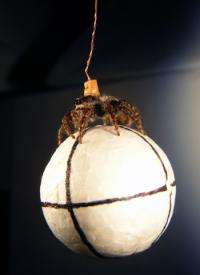
(PhysOrg.com) -- The most striking feature of jumping spiders is their arsenal of big eyes. In contrast to web-building spiders, they rely on their excellent vision to actively hunt and catch their insect prey. New research gives an insight into just how incredibly sophisticated the jumping spider's vision actually is, and explains why they are such an effective predator.

As published in the , and highlighted in the current issue journal Nature, Daniel Zurek and his colleagues from Macquarie University, Australia, decided to test the functioning ability of just one of the three sets of eyes of the species Servaea vestita. Using removable dental silicone they covered the larger central pair of eyes and the pair positioned more to the rear of the spiders' heads, leaving just the smaller forward-facing pair of eyes (the anterior lateral eyes) uncovered.

They then showed the spiders moving dots on a screen as well as tethered live house flies, favoured prey of the spiders, and recorded their responses to each, replicating this experiment with 52 individual spiders.

"Even when the spiders were confined to from this secondary pair of eyes, they could respond to targets that are very hard for other animals to see. They were able to detect, stalk and attack flies, which was unexpected," Zurek says.

"We believe this pair of eyes could have been underestimated by scientists in the past, and may be the most versatile element of their visual system, providing both spatial acuity and motion detection.

"It's astonishing that these animals, which have a body length of just 12 millimetres and a brain a fraction of the size of a honeybee's, have developed such a sophisticated visual system covering almost 360 degrees with such high resolution," he added.

"They divvy up different visual tasks, such as motion detection or high acuity detail analysis across the various sets of eyes, and it is likely that this modular approach helps the to handle the computational demands of vision."

Explore further: Front-row seats to climate change

Provided by Macquarie University

5 /5 (6 votes)

Related Stories

Mosquitoes supply spider with blood

Oct 11, 2005

Scientists in Sydney, Australia, say they've determined an East African species of jumping spider prefers to prey on blood-engorged female mosquitoes. And that, the Macquarie University researchers said, demonstrates a rare ...

Plant and animal in direct competition for food

May 13, 2010

(PhysOrg.com) -- Animals often compete aggressively with each other for food or other resources, and plants often compete with each other for light, water, or other resources. Now scientists in the U.S. have ...

Study: Crickets 'forewarn' unborn babies about spiders

Feb 17, 2010

Just because cricket moms abandon their eggs before they hatch doesn't mean they don't pass wisdom along to their babies. New research in the American Naturalist shows that crickets can warn their unborn babies about potent ...

Recommended for you

Front-row seats to climate change

12 hours ago

By day, insects provide the white noise of the South, but the night belongs to the amphibians. In a typical year, the Southern air hangs heavy from the humidity and the sounds of wildlife.

Captured in silken netting and sticky hairs

May 16, 2013

The great ecological success of spiders is often substantiated by the evolution of silk and webs. Biologists of the Kiel University and the University of Bern now found an alternative adaptation to hunting ...

User comments : 0

More news stories

Front-row seats to climate change

By day, insects provide the white noise of the South, but the night belongs to the amphibians. In a typical year, the Southern air hangs heavy from the humidity and the sounds of wildlife.

Climate change may have little impact on tropical lizards

A new Dartmouth College study finds human-caused climate change may have little impact on many species of tropical lizards, contradicting a host of recent studies that predict their widespread extinction in a rapidly warming ...

US seizes Bitcoin operator accounts

US authorities seized the accounts of a Bitcoin digital currency exchange operator, claiming it was functioning as an "unlicensed money service business," court documents showed Friday.

Chinese, Indian airlines face EU pollution fines

Eight Chinese and two Indian airlines face fines of up to several million euros for not paying for their greenhouse gas emissions during flights within the bloc, the European Commission said on Friday.