Japanese probe yields insights into Moon's inner life
Jul 04, 2010
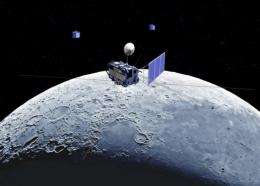
This illustration, released by the Japan Exploration Agency (JAXA) in 2007, shows a lunar observation satellite Kaguya. Japanese astronomers on Sunday said they had found traces of a mineral that adds an important piece of knowledge to the puzzle of the Moon's geological past.

Japanese astronomers on Sunday said they had found traces of a mineral that adds an important piece of knowledge to the puzzle of the Moon's geological past.

Using a instrument-laden probe, Kaguya, which was placed in orbit around the Moon in 2007, the team found abundant signatures of the mineral in concentric rings in three big crater regions.

The mineral, called olivine, is deemed to be a telltale of mantle, the deep inner layer of iron- and magnesium-rich rock that lies beneath the Moon's crust.

A leading theory is that the Moon was created about 4.5 billion years ago after the "Big Whack" -- it was ripped from Earth after our planet suffered a gigantic collision from some space object.

As the material coalesced into a ball, its surface gradually cooled, forming a crust made of a light-coloured aluminous mineral, feldspar, which floated in a dense, molten liquid.

Kaguya's data add a chapter to this "lunar magma ocean" hypothesis.

It suggests that after the crust had formed, there was some massive overturn in the fiery liquid beneath. Olivine-rich mantle was brought from deep within the lunar bowels to within the base of the crust.

At the craters sampled by the probe -- the South Pole-Aitken, Imbrium and Moscoviense impact basins -- the Moon's crust is very thin, and the olivine mantle may have been exposed by asteroids that smashed into the , the paper suggests.

The Moon's crust is believed to be far thicker than Earth's, averaging around 70 kilometres (45 miles) in depth, although the thickness varies significantly.

The structure and origins of the Moon's have been fiercely debated by astro-geologists.

The famous rocks brought back by the Apollo missions shed no light on the question, as they were all from the lunar crust. As a result, pointers to the existence of the were, for decades, either sketchy or indirect.

The study, published online by the journal Nature , is headed by Satoru Yamamoto of the National Institute for Environmental Studies in Tsukuba.

Explore further: Field tests in Mojave Desert pave way for human exploration of small bodies

add to favorites email to friend print save as pdf

Related Stories

Biggest, Deepest Crater Exposes Hidden, Ancient Moon

Mar 04, 2010

(PhysOrg.com) -- Shortly after the Moon formed, an asteroid smacked into its southern hemisphere and gouged out a truly enormous crater, the South Pole-Aitken basin, almost 1,500 miles across and more than ...

New high-res map suggests little water inside moon

Feb 12, 2009

(PhysOrg.com) -- The most detailed map of the Moon ever created has revealed never-before-seen craters at the lunar poles. The map is also revealing secrets about the Moon's interior -- and ...

Scientist's Award Allows Her To Probe the Earth's Mantle

Jun 11, 2010

(PhysOrg.com) -- Sandwiched between the liquid iron outer core and the thin rocky crust we live on, the Earth's mantle is more than 1,800 miles thick, and comprises more than three-quarters of the planet's volume and nearly ...

Probing Question: What heats the earth's core?

Mar 30, 2006

Although we crust-dwellers walk on nice cool ground, underneath our feet the Earth is a pretty hot place. Enough heat emanates from the planet's interior to make 200 cups of piping hot coffee per hour for each ...

Recommended for you

Mars rover Opportunity examines clay clues in rock

21 hours ago

(Phys.org) —NASA's senior Mars rover, Opportunity, is driving to a new study area after a dramatic finish to 20 months on "Cape York" with examination of a rock intensely altered by water.

NASA's STEREO detects a CME from the sun

May 17, 2013

On 5:24 a.m. EDT on May 17, 2013, the sun erupted with an Earth-directed coronal mass ejection or CME, a solar phenomenon that can send billions of tons of solar particles into space that can reach Earth ...

Nine-year-old Mars rover passes 40-year-old record

May 17, 2013

While Apollo 17 astronauts Eugene Cernan and Harrison Schmitt visited Earth's moon for three days in December 1972, they drove their mission's Lunar Roving Vehicle 19.3 nautical miles (22.210 statute miles ...

Bright explosion on the Moon

May 17, 2013

For the past 8 years, NASA astronomers have been monitoring the Moon for signs of explosions caused by meteoroids hitting the lunar surface. "Lunar meteor showers" have turned out to be more common than anyone ...

User comments : 1

Adjust slider to filter visible comments by rank

Display comments: newest first

omatumr
2.5 / 5 (2) Jul 04, 2010
Lunar olivine may contain evidence of the Moon's origin - as a fragment from Earth or as a separate body.

With kind regards,
Oliver K. Manuel

More news stories

Galaxy's Ring of Fire

Johnny Cash may have preferred this galaxy's burning ring of fire to the one he sang about falling into in his popular song. The "starburst ring" seen at center in red and yellow hues is not the product of ...

Earth's center is out of sync

(Phys.org) —We all know that the Earth rotates beneath our feet, but new research from ANU has revealed that the center of the Earth is out of sync with the rest of the planet, frequently speeding up and ...