Scientists warn increase in Amazon fires threatens UN-led carbon savings
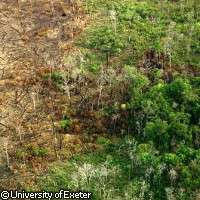
(PhysOrg.com) -- Research at the University of Exeter in the UK has revealed that farmers in the Amazon are lighting more fires in areas with reduced deforestation, and thereby threatening to cancel out carbon savings achieved by United Nations (UN) measures. Naturally occurring fires are rare in the Amazon, but Brazilian farmers frequently burn agricultural land every three to five years to improve soil nutrients and keep the land at an optimal level to produce food. The research, funded by the UK's National Environment Research Council (NERC), was presented in the journal Science.
By analysing satellite deforestation and fire data from the world's largest rainforest (the land cover map was provided by the European Commission's Joint Research Centre (JRC)), the scientists found that fire occurrence rates have swelled in 59% of areas with reduced deforestation.
The extra carbon emitted by the leakage of fires from farms into the surrounding forests may partially negate carbon savings achieved through the UN's Reducing Emissions from Deforestation and Degradation (REDD) programme, according to the scientists. REDD is a trust fund aimed at encouraging changes in forest management behaviour through appropriate financial reward.
'Changes in fire frequency could jeopardise the benefits achieved through the UN-REDD programme as trends in fires are the opposite of trends in deforestation,' said researcher Dr Luiz Aragão, an environmental scientist at the university's School of Geography.
He suggested that if the UN-REDD programme does not adopt sustainable fire-free land-management of deforested areas, any carbon savings achieved by avoiding deforestation will be partially offset by increased emissions from fires. 'Despite UN-REDD's vital importance in this region, fire is currently neglected in the emerging UN framework,' commented Dr Aragão.
Dr Aragão, along with his colleague Dr Shimabukuro, urged negotiators to take this point into consideration in future UN climate change talks. 'The efficacy of REDD as a climate change mitigation strategy depends, in particular, upon the stabilization of deforestation and degradation of the world's largest rainforest, the Amazon,' the scientists said.
'We need to change the way Amazonian people use and manage their land so that they can do this without fire,' Dr Aragão explained. 'They would need financial assistance for machinery, training and technical support to enable them to comply with implementation and maintenance of fire-free management of their land.'
By changing land management practices in already deforested areas to fallow management and introducing more diversified and sustainable agricultural practices at a cooperative community level, it is possible to drastically reduce fires and carbon emissions. 'It would be expensive but it would protect the stability of Amazonian carbon stocks and diversity,' he insisted.
The researchers underlined that in order to encourage such practices more investments were needed 'in addition to the REDD finance mechanism.' These funds would 'support eco-friendly land-use practices within local communities and Amazonian farmers and for monitoring systems that permit quantification of different types of forest degradation and secondary forest dynamics,' said Drs Aragão and Shimabukuro.
Moreover, they highlighted that failure to tackle fire use in the Amazon could 'discourage investors and donors within the REDD framework because of the risk that gains through deforestation reduction may be outweighed by carbon losses resulting from fire, and because of the lack of a comprehensive and reliable system for monitoring, reporting, and verifying emissions (MRV)'.
The UN estimates that deforestation accounts for up to a fifth of all greenhouse gases released by human activities. This latest study found that deforestation in the Brazilian Amazon has meant an annual loss of 19 000 square kilometres (sq km) of forest from 1998-2007, releasing 280 million tonnes of carbon a year. In recent years, extra fires probably emitted as much carbon as deliberate clearing of trees, a total comparable to an estimated 450 million tonnes of carbon soaked up by the forest every year, the scientists concluded.
Provided by University of Exeter


