Get moving: Cancer survivors urged to exercise
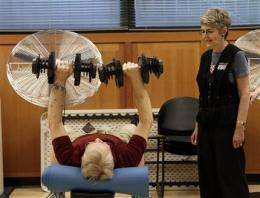
(AP) -- Cancer survivors, better work up a sweat. New guidelines are urging survivors to exercise more, even - hard as it may sound - those who haven't yet finished their treatment.
There's growing evidence that physical activity improves quality of life and eases some cancer-related fatigue. More, it can help fend off a serious decline in physical function that can last long after therapy is finished.
Consider: In one year, women who needed chemotherapy for their breast cancer can see a swapping of muscle for fat that's equivalent to 10 years of normal aging, says Dr. Wendy Demark-Wahnefried of the University of Alabama at Birmingham.
In other words, a 45-year-old may find herself with the fatter, weaker body type of a 55-year-old.
Scientists have long advised that being overweight and sedentary increases the risk for various cancers. Among the nation's nearly 12 million cancer survivors, there are hints - although not yet proof - that people who are more active may lower risk of a recurrence. And like everyone who ages, the longer cancer survivors live, the higher their risk for heart disease that exercise definitely fights.
The American College of Sports Medicine convened a panel of cancer and exercise specialists to evaluate the evidence. Guidelines issued this month advise cancer survivors to aim for the same amount of exercise as recommended for the average person: about 2 1/2 hours a week.
Patients still in treatment may not feel up to that much, the guidelines acknowledge, but should avoid inactivity on their good days.
"You don't have to be Lance Armstrong," stresses Dr. Julia Rowland of the National Cancer Institute, speaking from a survivorship meeting this month that highlighted exercise research. "Walk the dog, play a little golf."
But how much exercise is needed? And what kind? Innovative new studies are under way to start answering those questions, including:
-Oregon Health and Science University is training prostate cancer survivors to exercise with their wives. The study will enroll 66 couples, comparing those given twice-a-week muscle-strengthening exercises with pairs who don't get active.
Researchers think exercising together may help both partners stick with it. They're also testing if the shared activity improves both physical functioning and eases the strain that cancer puts on the caregiver and the marriage.
"It has the potential to have not just physical benefits but emotional benefits, too," says lead researcher Dr. Kerri Winters-Stone.
-Demark-Wahnefried led a recent study of 641 overweight breast cancer survivors that found at-home exercises with some muscle-strengthening, plus a better diet, could slow physical decline.
-Duke University is recruiting 160 lung cancer patients to test if three-times-a-week aerobic exercise, strength training or both could improve their fitness after surgery. Lung cancer has long been thought beyond the reach of exercise benefits because it's so often diagnosed at late stages. But Duke's Dr. Lee Jones notes that thousands who are caught in time to remove the lung tumor do survive about five years, and he suspects that fitness - measured by how well their bodies use oxygen - plays a role.
People with cancer usually get less active as symptoms or treatments make them feel lousy. Plus, certain therapies can weaken muscles, bones, even the heart. Not that long ago, doctors advised taking it easy.
Not anymore: Be as active as you're able, says Dr. Kathryn Schmitz of the University of Pennsylvania, lead author of the new guidelines.
"Absolutely it's as simple as getting up off the couch and walking," she says.
Exercise programs are beginning to target cancer survivors, like Livestrong at the YMCA, a partnership with cycling great and cancer survivor Lance Armstrong's foundation. The American College of Sports Medicine now certifies fitness trainers who specialize in cancer survivors.
But anyone starting more vigorous activity for the first time or who has particular risks - like the painful arm swelling called lymphedema that some breast cancer survivors experience - may need more specialized exercise advice, Schmitz says. They should discuss physical therapy with their oncologist, she advises.
For example, Schmitz led a major study that found careful weight training can protect against lymphedema, reversing years of advice to coddle the at-risk arm. But the average fitness trainer doesn't know how to safely offer that special training, she cautions.
Mary Lou Galantino of Wilmington, Del., is a physical therapist who specializes in cancer care - and kept exercising when her own breast cancer was diagnosed at Penn in 2003. Then 42, she says she was on the treadmill within 24 hours of each chemo session, to stay fit enough to care for her two preschoolers.
"You can feel more energy" with the right exercise, says Galantino, a physical therapy professor at the Richard Stockton College of New Jersey. "I was giving my body up to the surgeons and chemo, but I could take my body back through yoga and aerobic exercise."
©2010 The Associated Press. All rights reserved. This material may not be published, broadcast, rewritten or redistributed.


