NASA watching System 94L over Lesser Antilles for development
Jun 18, 2010
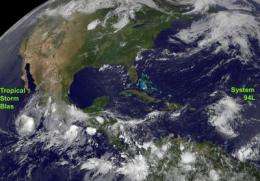
The GOES-13 satellite captured a visible image of System 94L (right) over the Lesser Antilles on June 18 at 7:45 a.m. EDT as a large area of cloudiness, and Tropical Storm Blas is visible in the Eastern Pacific Ocean off the Mexican coast (left). Credit: NASA GOES Project

Tropical waves can't escape the view of satellites, and System 94L which is associated with a strong tropical wave in western Atlantic Ocean and over the Lesser Antilles is being watched for development.

The known as GOES-13 captured a visible image of System 94L over the Lesser Antilles on June 18 at 11:45 UTC (7:45 a.m. EDT). System 94L appears as a large area of clouds over the group of islands. GOES-13 was launched by NASA and is now operated by the National Oceanic and Atmospheric Administration (NOAA). NASA's GOES Project at the Goddard Space Flight Center in Greenbelt, Md. created the latest satellite image.

System 94L is associated with a strong tropical wave that's producing a large area of showers and thunderstorms as it heads west-northwest over the Lesser Antilles. The Lesser Antilles lie on the eastern end of the Caribbean Sea and on the western boundary with the .

On June 18, System 94L was moving through the Lesser Antilles and bringing some heavy rainfall and gusty winds to that group of islands. The Lesser Antilles include the smaller islands of the Caribbean: the Virgin Islands and the Windward Islands and Leeward Islands.

Heavy rain and gusty winds from System 94L are expected to move over areas of the Leeward Islands, Virgin Islands and Puerto Rico over the weekend. System 94L is forecast to move west-northwestward over the weekend and on June 18, it was traveling that direction at 15 mph.

The National Hurricane Center noted that "Upper-level winds are expected to remain unfavorable for development and there is a low chance, about 20 percent, that this system will become a tropical cyclone during the next 48 hours."

Explore further: Professor argues Earth's mantle affects long-term sea-level rise estimates

add to favorites email to friend print save as pdf

Related Stories

System 92L's chances for development are waning

Jun 15, 2010

Satellite imagery captured a visible look at System 92L earlier today, and it seems to be running into an environmental road block: upper level winds that are lessening its chances for development into a tropical ...

NASA satellite reveals a depressed and disorganized Henri

Oct 08, 2009

Depression happens to everyone, even tropical storms, and Henri is now tropically depressed. NASA satellite imagery has confirmed he's weakened to a tropical depression and he is further expected to degenerate ...

Still a low chance of development for two lows

Jul 22, 2009

The two areas of thunderstorms in the Caribbean from yesterday, July 21, are on the move. One area is now moving into out of the Caribbean and into the eastern Atlantic Ocean while the other is now moving ...

Recommended for you

Strong earthquake at exceptional depth

7 hours ago

This morning at 05:45 CEST, the earth trembled beneath the Okhotsk Sea in the Pacific Northwest. The quake, with a magnitude of 8.2, took place at an exceptional depth of 605 kilometers. Because of the great ...

Marine forecasting on the horizon for Indian Ocean Rim

7 hours ago

Nearly all of the member countries of the Indian Ocean Rim Association for Regional Cooperation (IOR-ARC) will attend the week-long workshop to further cooperation and understanding on international ocean ...

Russia evacuates drifting Arctic research station

May 23, 2013

Russia has ordered the urgent evacuation of the 16-strong crew of a drifting Arctic research station after ice floe that hosts the floating laboratory began to disintegrate, officials said Thursday.

User comments : 1

Adjust slider to filter visible comments by rank

Display comments: newest first

uuhhmmm
not rated yet Jun 19, 2010
oil does not freeze.... and stays hotter than water for longer.......storms will form around the oil first....... tropical storms could spread oil massively on to land.

More news stories

Dark, massive asteroid to fly by Earth on May 31

It's 1.7 miles long. Its surface is covered in a sticky black substance similar to the gunk at the bottom of a barbecue. If it impacted Earth it would probably result in global extinction. Good thing it is ...

Source of life running out: water scientists

The majority of people on Earth people will face severe water shortages within a generation or two if pollution and waste continues unabated, scientists warned at a conference in Bonn Friday.